Carbon-negative building materials are redefining sustainable construction. Unlike low carbon or carbon-neutral materials, these innovative solutions absorb more CO₂ than they emit across their lifecycle. From CLT wood to hempcrete and cement-free concrete, these materials are not just reducing emissions, they are actively acting as carbon sinks. Learn how these materials integrate into modern construction, contributing to climate change mitigation and energy efficiency.
Carbon Negative Building Materials: The Construction Revolution Capturing CO₂
| Material / Type | Commercial Example | Density (kg/m³) | Compressive Strength (MPa) | Net CO₂ Footprint | Estimated Price |
|---|---|---|---|---|---|
| CLT Wood | KLH, Katerra, Stora Enso | 350–600 | ~30–40 | ~–0.9 tCO₂/t (includes capture) | $400–$600/m³ |
| Bamboo | Moso Bamboo, BambooWilde | 500–900 | 40–80 | >0 (negative if intensive cultivation) | $100–$200/m³ |
| Hemp (Hempcrete) | IsoHemp, NatuRem (blocks) | 100–300 | 0.5–1.5 | –0.1 to –0.5 tCO₂/m³ | $80–$150/m³ |
| Biochar / Plant-Based Carbon | CarbonGold, Carbicrete (filler) | 200–400 | N/A (additive) | – (fixes biogenic carbon) | $200–$400/t |
| Cement-Free Concrete | CarbiCrete, CarbonCure, BluePlanet | 2000–2400 | 20–50 | – (up to –0.1 tCO₂/t in blocks) | $120–$160/m³ |
| Plant Fiber Insulation | Hemp Insulation, IsoHemp Spritz | 100–200 | 0.3–0.7 | –0.05 to –0.1 tCO₂/m³ | $40–$80/m³ |
History and Evolution
The concept of carbon negative construction builds on centuries of bioconstruction traditions, like adobe and timber houses, but has surged in relevance with 21st-century climate initiatives. Key milestones include:
- FSC/PEFC certified wood as a carbon sink.
- Emergence of carbon-neutral and carbon-positive buildings.
- Technological innovations: EcoPaja prefabricated straw panels, Partanna carbon-negative concrete, ESM (Enzymatic Structural Material).
Key Processes and Technologies
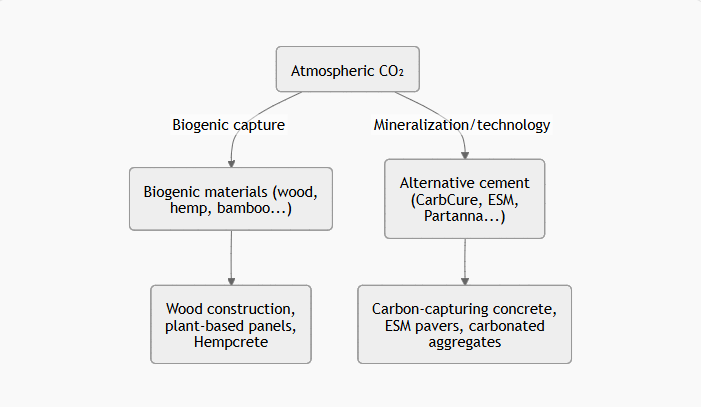
Biogenic Capture
Rapidly growing plants like bamboo, hemp, and sustainable wood absorb CO₂ during growth. When transformed into building materials, this carbon is locked into structures permanently. Example: CLT panels store ~0.5 tCO₂ per m³. Biochar can be added to mortars or soil mixes for additional carbon retention.
Mineral Sequestration and Carbonation
Industrial techniques inject CO₂ into fresh concrete or mineral aggregates. Technologies like CarbonCure and Carbix transform CO₂ into stable carbonates, permanently reducing concrete’s footprint.
Innovative Binders and Cement Alternatives
New cementitious compounds, including magnesian cements and enzymatic binders (ESM), absorb CO₂ during curing. Companies like Partanna and Brimstone are commercializing these solutions with competitive pricing versus Portland cement.
Emerging Techniques
Plant based polymers, algae composites, and mycelium insulation provide scalable carbon negative solutions for lightweight construction and interior finishes.
Types of Materials and Properties
- CLT / Engineered Wood: High structural efficiency, stores CO₂, ideal for multi-story buildings.
- Bamboo: Rapidly renewable, high strength, suitable for framing and panels.
- Hempcrete: Lightweight, excellent thermal and moisture insulation; fixes 100–250 kgCO₂/m³.
- Biochar & Plant-Based Fillers: Non-structural, additive role in carbon capture.
- Cement-Free Concrete: Reduces traditional cement use, fixes CO₂ during curing.
- Plant Fiber Insulation: Enhances energy efficiency, non-toxic, and carbon-negative.
Companies and Flagship Projects
- Partanna (Bahamas): Carbon-negative concrete for homes and Red Sea Global pavements.
- CarbiCrete (Canada): Cement-free blocks, 20× lower carbon footprint.
- CarbonCure (Canada): Global retrofit solutions, 450 ktCO₂ avoided.
- Plantd (USA): Structural panels from perennial grasses.
- EcoPaja (Spain): Prefabricated straw homes, 90% CO₂ reduction.
- ESM (WPI, USA): Enzymatic concrete capturing 6 kg CO₂/m³.
Environmental, Economic, and Social Benefits
- Environmental: Substantial CO₂ reduction, improved energy efficiency, biodegradable or recyclable.
- Social/Health: Improved indoor air quality, moisture regulation, faster and safer construction.
- Economic: Long-term cost savings, new rural markets, carbon credit opportunities.
Barriers, Risks, and Limitations
- Higher initial costs and limited supply chains.
- Regulatory gaps; traditional codes favor Portland cement or steel.
- Need for technical training and quality assurance.
- Scalability challenges for emerging technologies.
Market Trends and Scalability
Global interest is rising in carbon-negative construction:
- Canada, Germany, USA lead startup innovation.
- Europe: Belgium, UK, Scandinavia, Austria.
- Asia-Pacific: China, India exploring cement alternatives and hempcrete.
- Estimated potential: replacing a fraction of conventional concrete with carbon-negative materials could remove >0.5 GtCO₂ annually.
Recommendations for Architects, Builders, and Regulators
- Incorporate LCA (Life Cycle Analysis) and certified carbon-negative materials.
- Take advantage of LEED, FSC, PEFC, BREEAM, WELL certifications.
- Encourage pilot projects and government incentives.
- Promote awareness about benefits and successful case studies.
Frequently Asked Questions (FAQ)
Q1: What are carbon-negative building materials?
Materials that absorb more CO₂ than they emit during their lifecycle.
Q2: How is net CO₂ footprint measured?
Through LCA (cradle-to-grave) assessments, factoring in emissions and carbon captured.
Q3: Which materials are most effective?
CLT wood, hempcrete, cement-free concrete, and biochar-based composites.
Q4: Are there certifications to ensure carbon-negativity?
Yes, including LEED v4, FSC/PEFC, Verra VCS, ISO 14067, BREEAM, and WELL.
Q5: What are the main adoption obstacles?
Costs, regulatory gaps, training needs, and limited supply chains.