Climate resilient infrastructure is rapidly becoming one of the most critical investments for governments, cities, and businesses worldwide. As extreme weather events intensify and climate risks increase, traditional infrastructure is no longer sufficient.
What Is Climate Resilient Infrastructure?
Climate resilient infrastructure refers to systems that are designed, built, and operated to anticipate, withstand, adapt to, and recover from climate related risks such as floods, heatwaves, storms, and rising sea levels.
This includes everything from transport networks and energy grids to water systems and urban developments.
A key distinction experts make is:
- Resilient infrastructure → protects the asset itself
- Infrastructure for resilience → protects people and communities
The most effective projects combine both approaches.
Recommended: Climate resilience
Why Climate Resilient Infrastructure Matters Today
Climate change is already affecting infrastructure systems worldwide. Roads are melting under extreme heat, floods are damaging transport networks, and energy systems are struggling with rising demand and instability.
From an economic perspective, the numbers are striking:
- Over $18 billion in annual infrastructure damage globally
- Expected to rise to $39 billion by 2040
- Total economic impact exceeding $100 billion when indirect losses are included
Because of this, governments and companies are investing heavily in resilience not just for environmental reasons, but for financial survival and long-term ROI.
How Climate Resilient Infrastructure Works
Climate resilient infrastructure is not just about building stronger assets it’s about managing risk across the entire lifecycle.
The process typically includes:
- Climate risk screening – identifying potential threats
- Risk assessment – analyzing vulnerability and exposure
- Design adaptation – integrating resilience into engineering
- Financing – often through public-private partnerships
- Monitoring and adjustment – adapting over time
For example, a coastal protection project might combine sea walls, natural barriers like mangroves, and real-time monitoring systems to reduce risk.
Core Principles of Climate Resilient Infrastructure
The most effective systems follow four key principles:
- Anticipation – predicting future climate risks
- Adaptation – adjusting to changing conditions
- Resistance – withstanding shocks
- Recovery – quickly restoring functionality
Because climate outcomes are uncertain, flexibility is critical. Many modern systems are designed to adapt over time rather than rely on fixed assumptions
Climate Resilient Infrastructure Across the Lifecycle
Resilience must be integrated at every stage:
- Planning – identifying risks early reduces costs
- Design – using materials and structures adapted to climate stress
- Construction – ensuring quality and durability
- Financing – aligning incentives through PPP models
- Operation – continuous monitoring and upgrades
Decisions made early in the lifecycle often determine 80% of long-term costs and performance.
Types of Climate Resilient Infrastructure Technologies and Solutions
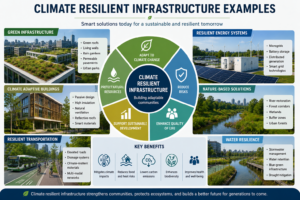
There are three main categories:
1. Structural Solutions
These include engineered systems such as:
- Flood barriers
- Elevated roads
- Reinforced bridges
They provide high reliability but often come with high costs.
Nature Based Solutions
These use ecosystems to reduce risk:
- Wetlands for flood control
- Mangroves for coastal protection
- Urban green spaces for heat reduction
They are often cheaper and provide environmental benefits.
Non Structural Solutions
These focus on management and policy:
- Early warning systems
- Insurance mechanisms
- Urban planning regulations
They are cost-effective and essential for long term resilience.
Recommended: Green infrastructure
Cost of Climate Resilient Infrastructure
Costs vary widely depending on scale and complexity.
Small Scale Projects
Typical cost:
- $50,000 to $500,000
Examples: - Drainage upgrades
- Small flood defenses
Large Scale Projects
Typical cost:
- $10 million to over $1 billion
Examples: - Coastal protection systems
- Transport infrastructure upgrades
Key Cost Factors
- Materials and engineering complexity
- Geographic risk level
- Labor and construction costs
- Maintenance requirements
ROI and Payback Period
Investing in resilience often delivers strong returns. Studies show benefit cost ratios of 4:1 or higher, meaning every dollar invested can save four dollars in future losses.
Best Climate Resilient Infrastructure Solutions
Here’s a simplified comparison:
- Nature-based solutions → best for low-cost, sustainable protection
- Smart infrastructure systems → best for urban monitoring and efficiency
- Engineering solutions → best for critical, high-risk assets
- Adaptive design systems → best for long-term flexibility
Nature Based Infrastructure
- Best for: coastal and flood-prone areas
- Cost: low to medium
- Pros: sustainable, cost-effective
- Cons: slower to implement
Smart Infrastructure Systems
- Best for: cities and urban systems
- Cost: medium
- Pros: high efficiency, real-time data
- Cons: requires technology investment
Climate Proof Engineering
- Best for: critical infrastructure
- Cost:high
- Pros: maximum durability
- Cons: expensive
Adaptive Design
- Best for: large, long-term projects
- Cost: medium to high
- Pros: flexible and future-proof
- Cons: complex planning
Benefits of Climate Resilient Infrastructure
Environmental Benefits
- Reduced greenhouse gas emissions through efficient systems
- Protection of ecosystems such as wetlands, forests, and coastal zones
- Improved water management and conservation
- Reduction in urban heat island effects
- Enhanced biodiversity through nature based solutions
Economic Benefits
- Lower long-term repair and maintenance costs
- Reduced financial losses from climate disasters
- Increased asset lifespan and durability
- Higher return on investment (ROI often 4:1 or more)
- Increased property values in protected areas
- Attraction of private investment and funding
- Reduced insurance premiums in lower-risk zones
Social Benefits
- Increased public safety during extreme weather events
- Greater reliability of essential services (water, energy, transport)
- Reduced disruption to communities and businesses
- Improved quality of life in urban areas
- Job creation in construction, engineering, and green sectors
- Protection of vulnerable populations
Regulatory Benefits
- Compliance with international climate policies and agreements
- Easier access to government funding and incentives
- Alignment with ESG (Environmental, Social, Governance) standards
- Reduced legal and liability risks
- Improved eligibility for climate finance programs
Strategic & Business Benefits
- Competitive advantage for companies adopting resilient systems
- Stronger brand reputation and sustainability positioning
- Improved investor confidence
- Better risk management and forecasting
- Long-term cost predictability
- Alignment with corporate sustainability goals
Challenges and Limitations
Technical Challenges
- Limited climate data
- Complex modeling
Financial Barriers
- High upfront costs
Regulatory Issues
- Lack of clear policies in some regions
World Examples
Examples include:
- Coastal cities using hybrid flood protection systems
- Energy grids adapting to extreme weather variability
These projects combine multiple solutions for maximum resilience.
Recommended: climate resilient infrastructure examples
Future Trends
The future of climate resilient infrastructure includes:
- Smart systems using AI and IoT
- Increased global investment (trillions expected)
- Integration with sustainability and ESG frameworks
Frequently Asked Questions
How much does climate resilient infrastructure cost?
From $50,000 for small projects to over $1 billion for large-scale systems.
Is it worth it?
Yes. Many projects achieve ROI of 4x or higher.
What is the best solution?
It depends on location, risk level, and budget.
What are the main benefits?
Cost savings, risk reduction, and improved reliability.