What Is Climate Resilience?
Definition of Climate Resilience
Climate resilience refers to the capacity of human, natural, and economic systems to anticipate, withstand, adapt to, and recover from climate related shocks and stresses, while preserving core functions and, when necessary, transforming to reduce long term risk.
Internationally recognized definitions include:
- IPCC:
The capacity of social, economic and environmental systems to cope with hazardous events or trends, responding or reorganizing in ways that maintain their essential function, identity and structure. - UNDRR (United Nations Office for Disaster Risk Reduction):
The ability of a system, community or society to resist, adapt to and recover efficiently from hazards. - BMZ (German Federal Ministry for Economic Cooperation and Development):
Climate resilience focuses on reducing structural vulnerabilities through systemic climate adaptation.
Climate resilience is not just about resistance. It is about learning, adapting, and transforming in response to climate risks.
Climate Resilience vs Adaptation vs Mitigation

| Concept | Purpose | Time Horizon | Example |
|---|---|---|---|
| Climate mitigation | Reduce emissions | Long term | Renewable energy |
| Climate adaptation | Adjust to impacts | Medium term | Flood defenses |
| Climate resilience | Absorb, adapt & recover | Continuous | Adaptive infrastructure |
Climate resilience integrates adaptation and risk management into a long term development strategy.
Core Principles of Climate Resilience

1. Anticipation and Climate Risk Management
- Climate scenarios and projections
- Risk modeling and vulnerability assessments
- Early warning systems
2. Systems Based Approach
- Water-energy–food nexus
- Avoids isolated, single-sector solutions
3. Flexibility and Adaptability
- Adaptive infrastructure design
- Dynamic policies that evolve with climate data
4. Diversification
- Multiple water, energy and food sources
- Reduced dependency on single systems
5. Social Inclusion and Climate Justice
- Prioritizing vulnerable populations
- Equity based adaptation planning
6. Multilevel Governance
- Local, national and international coordination
- Community participation
Principles of Climate Resilience and Practical Implications
| Principle | Practical Application |
|---|---|
| Anticipation | Climate risk mapping |
| Systemic thinking | Integrated planning |
| Flexibility | Modular infrastructure |
| Diversification | Mixed energy portfolios |
| Inclusion | Vulnerability based targeting |
| Governance | Participatory decision making |
Examples of Climate Resilience
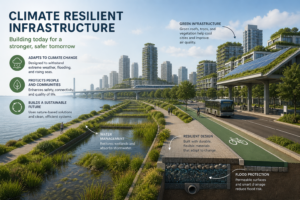
- Netherlands: Climate Resilient Infrastructure: “Room for the River” allows controlled flooding rather than relying solely on dikes, combining flood safety with ecosystem restoration.
- Bangladesh: Disaster Risk Reduction: advanced cyclone early-warning systems have dramatically reduced mortality, despite more frequent extreme events.
- Germany: Climate Resilient Cities: The Schwammstadt (sponge city) model uses permeable surfaces, green roofs, and urban vegetation to manage heat and heavy rainfall.
- Sub Saharan Africa: Climate Smart Agriculture: Drought-resistant crops, agroforestry, and climate information services strengthen food security.
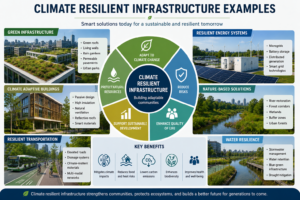
Recommended: climate resilient infrastructure examples
Climate Resilience in Global Policies and Regulations
Paris Agreement
- Recognizes adaptation as equal to mitigation
- National Adaptation Plans (NAPs)
Sendai Framework for Disaster Risk Reduction
- Preventive risk management
- Climate risk integration into land use planning
European Union Climate Adaptation Strategy
- Mandatory resilience integration in critical infrastructure
Climate Adaptation Strategies That Build Resilience
| Strategy | Description | Example |
|---|---|---|
| Ecosystem based adaptation | Nature based solutions | Mangroves |
| Structural adaptation | Climate proof infrastructure | Flood resistant buildings |
| Social adaptation | Capacity building | Community training |
| Transformational adaptation | Systemic change | Planned relocation |
Climate Resilience Across Key Sectors
Agriculture
- Diversified crops
- Efficient irrigation
- Climate information services
Infrastructure
- Future climate design standards
- Green infrastructure
Health
- Heat health action plans
- Climate resilient hospitals
Energy
- Decentralized renewables
- Resilient power grids
Water and Sanitation
- Integrated water resource management
- Water reuse
Education
- Climate literacy
- Technical training for decision makers
Climate Resilience and Environmental Impact Assessment (EIA)
Should be embedded into EIA processes by:
- Using dynamic climate baselines
- Assessing future climate impacts, not only current conditions
- Informing adaptive environmental management plans