Summary Table of Climate Resilient Infrastructure
| Infrastructure Type | Example | Location | Technologies | Benefits | Organizations |
|---|---|---|---|---|---|
| Green Urban | City in a Garden | Singapore | Green roofs, IoT sensors | Temp ↓ 4°C | URA, CPG |
| Coastal | Green Polders | Bangladesh | Mangroves, GIS | Mortality ↓ 60% | BRAC |
| Sponge City | Wuhan | China | Smart drainage, BIM | Flood ↓ 80% | MOHURD |
| Energy | Puerto Rico Microgrid | Puerto Rico | Solar + batteries | Energy resilience | Tesla |
| Buildings | Bullitt Center | USA | Net-zero systems | Energy +60% | Miller Hull |
| Biodiversity | Yellowstone to Yukon | USA/Canada | Wildlife monitoring | Species recovery | Y2Y |
What Is Climate Resilient Infrastructure?
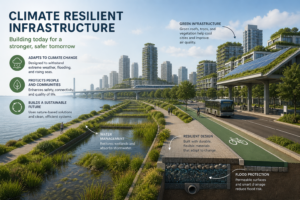
Climate resilient infrastructure refers to systems, buildings, and urban designs specifically engineered to withstand, adapt to, and recover from climate change impacts such as floods, heatwaves, hurricanes, droughts, and sea-level rise.
Unlike traditional infrastructure, these systems integrate:
- Nature based solutions (NbS)
- Smart technologies (IoT, AI, digital twins)
- Adaptive design principles
The goal is not just resistance but long-term adaptability and multi-functional performance.
Recommended: Climate Resilient Infrastructure
Why Climate Resilient Infrastructure Is Critical for Modern Cities
As extreme weather events intensify globally, cities face:
- Rising economic losses
- Infrastructure failures
- Increased human vulnerability
Climate resilient infrastructure delivers measurable benefits:
- Up to 80% reduction in flood damage
- 2–4°C urban temperature reduction
- 30–50% savings in water treatment costs
- Faster recovery after disasters
For governments, investors, and developers, it represents one of the highest ROI strategies in climate adaptation.
Types of Climate Resilient Infrastructure and Real Examples
1. Green Urban Infrastructure
Green roofs, living walls, rain gardens, sponge parks
Integrates vegetation and natural systems into the built environment to manage rainwater, heat, and urban pollution. It is based on the principle that nature can provide more efficient and durable engineering services than conventional solutions.
| Characteristics | Technologies | Benefits |
|---|---|---|
| • Green roofs (extensive and intensive) with lightweight substrate • Self-supporting vegetated walls with hydroponic systems • Rain gardens and biofilters for stormwater capture • Permeable pavements allowing soil infiltration • Parks designed as multifunctional water “sponges” • Urban tree corridors reducing heat island effect | • Lightweight moisture-retaining substrates (perlite, vermiculite) • IoT soil moisture sensors with real-time telemetry • Automated drip irrigation systems with climate control • Porous materials such as permacrete and permeable asphalt • Native drought-resistant plants (xeriscaping) | • Urban temperature reduction up to 4°C • Retention of up to 70% of stormwater runoff • CO₂ capture and PM2.5 filtration • Increased urban biodiversity (pollinators, birds) • Improved mental well-being and quality of life |
Singapore : City in a Garden
- Location: Singapore
- Year: 2009–present
- Organizations: URA + CPG Consultants
- Description:
Singapore has implemented one of the world’s most ambitious urban greening strategies, mandating more than 200 hectares of green roofs. Jewel Changi Airport integrates a 40-meter indoor waterfall surrounded by vegetation, functioning as a climate-regulating ecosystem and public attraction. - 🔗 https://www.safdiearchitects.com/projects/jewel-changi-airport
Medellín – Green Corridors
- Location: Colombia
- Year: 2016–2019
- Organizations: Medellín Government + EDU
- Description:
The project transformed 18 major urban corridors by planting more than 120,000 trees and shrubs. This intervention reduced local temperatures by up to 3°C and significantly improved air quality and urban livability. - 🔗 https://www.medellin.gov.co/es/secretaria-medio-ambiente/medellin-biodiversa/corredores-y-muros-verdes/
Portland – Green Streets
- Location: USA
- Year: 2003–present
- Organizations: Bureau of Environmental Services
- Description:
Portland pioneered neighborhood-scale rain gardens. The “Green Streets” program includes over 2,000 installations capturing up to 80% of stormwater runoff, reducing sewer overflows and pollution.
2.Coastal Adaptive Infrastructure
| Characteristics | Technologies | Benefits |
|---|---|---|
| • Artificial reefs for coral colonization •Mangrove restoration as natural barriers •Reinforced dunes with vegetation •Hybrid dikes combining soft and hard infrastructure •Early warning systems for coastal hazards | • Bioengineered reef modules • Lidar and SAR coastal monitoring • GPS-enabled mangrove planting drones • 3D hydraulic flood modeling • Geocell coastal reinforcement systems | • Wave energy reduction up to 70% • Habitat restoration • Carbon sequestration (5–10 t CO₂/ha/year) • Lower cost vs concrete infrastructure • Protection of vulnerable populations |
Bangladesh – Green Polders
- Location: Bangladesh
- Year: 2010–present
- Organizations: BRAC + WorldFish Center + Gobierno de Bangladesh (BWDB)
- Description:
Restoration of 70,000 hectares of mangroves combined with internal dikes. Reduced mortality during Cyclone Amphan by 60%. - 🔗 Manglares y polders verdes, Bangladesh
New York – Living Breakwaters
- Location: New York
- Year: 2014–2022
- Organizations: BIG (Bjarke Ingels Group) + SCAPE Landscape Architecture + U.S. Army Corps of Engineers
- Description:
2.7 km of artificial reefs built after Hurricane Sandy reduced wave energy by 50% while restoring oyster ecosystems. 🔗 https://www.scapestudio.com
Netherlands – Sand Engine
- Location:Netherlands
- Year: 2011–2013
- Organizations: Rijkswaterstaat + Boskalis Westminster
- Description:
Portland pioneered neighborhood-scale rain gardens. The “Green Streets” program includes over 2,000 installations capturing up to 80% of stormwater runoff, reducing sewer overflows and pollution. - 🔗 https://blogs.worldbank.org/en/endpovertyinsouthasia/mangroves-and-coastal-protection-potential-triple-win-bangladesh
3. Sponge Cities
| Characteristics | Technologies | Benefits |
|---|---|---|
| •Vegetated infiltration systems •Retention basins •Dual water networks •Controlled flood zones •Blue-green corridors | • IoT water sensors •Hydrological BIM modeling •High-permeability pavements •SUDS systems •Digital twin simulations | • Flood reduction up to 80% • Aquifer recharge • Urban cooling • Reduced water treatment costs • Ecological restoration |
Wuhan – Sponge City
- Location: China · Wuhan, Hubei
- Year: 2015–2025
- Organizations:(MOHURD) + Turenscape (Kongjian Yu
- Description:
Wuhan is one of the 30 pilot cities under China’s national Sponge City Initiative launched in 2015. The plan includes the transformation of approximately 2,000 km² of urban area. One of its flagship projects, Yanweizhou Wetland Park, was designed to absorb seasonal flooding and successfully withstood the historic floods of 2016 without suffering structural damage, proving the effectiveness of landscape-based flood management systems.
Denmark · Copenhagen
- Location: Denmark · Copenhagen
- Year: 2012–2035
- Organizations:COWI + Ramboll + Municipality of Copenhagen
- Description:
Following severe flooding in 2011 that caused damages of 6,000 million DKK, Copenhagen developed the Klimakvarter plan, Europe’s first climate-resilient neighborhood. The initiative includes over 300 projects focused on stormwater management and urban adaptation. With an investment of 15,000 million DKK, the plan is expected to prevent up to 40,000 million DKK in future damages, making it one of the most cost-effective climate adaptation strategies globally. - 🔗 https://www.cowi.com
Mexico · Monterrey, Nuevo León
- Location: México · Monterrey, Nuevo León
- Year: 2018–2023
- Organizations: GreenLab MX + ITESM + SADM
- Description:
The La Huasteca–Santa Catarina corridor project involved the restoration of 12 km of the Santa Catarina River using rain gardens, vegetated gabions, and linear parks. During Hurricane Grace in 2021, the project demonstrated its effectiveness by reducing flood damage in surrounding neighborhoods by approximately 35%, validating the role of nature based urban design in disaster risk reduction.
4. Resilient Energy Systems
| Characteristics | Technologies | Benefits |
|---|---|---|
| • Microgrids • Battery storage • Underground lines • Distributed generation • Smart reconnection systems | • V2G systems • Flow batteries • AI monitoring • PMU sensors • SCADA networks | • Faster recovery (10x) • Continuous energy supply • Renewable integration • Reduced transmission losses • Energy independence |
Puerto Rico
- Location: Puerto Rico
- Year: 2018–2021
- Organizations: Tesla Energy + AES + FEMA
- Description:
After Hurricane Maria in 2017 left 3.4 million people without electricity for up to 11 months, Tesla deployed more than 3,500 Powerwall battery systems across Puerto Rico. A notable installation in Casa Pueblo (Adjuntas) combines 100 kW of solar generation with 140 kWh of battery storage, allowing the community to maintain electricity during Hurricane Fiona in 2022, when much of the island again lost power.
United States · California
- Location: United States · California
- Year: 2021–2025
- Organizations: PG&E + Tesla + Shell Energy
- Description:
The Virtual Power Plant (VPP) program integrates 50,000 residential battery systems into a distributed network capable of delivering 250 MW of power. During the September 2022 heatwave, the system injected up to 80 MW into the grid during peak demand, preventing blackouts for approximately 1.5 million households.
Denmark · Bornholm Island
- Year:2006–2015
- Organizations: Ørsted + Danish Energy Agency + IBM
- Description:
The EcoGrid EU project transformed Bornholm into a large-scale smart grid laboratory involving 5,000 households. The system allows real-time demand response based on electricity pricing, achieving reductions of 15–20% in peak consumption. The model has since been replicated in multiple European countries.
Climate-Adaptive Buildings
| Characteristics | Technologies | Benefits |
|---|---|---|
| • Passive design • High insulation • Natural ventilation • Reflective roofs • Double façades | • Phase change materials • Smart glass • CLT structures • Geothermal systems • CFD simulations | • Energy savings (60–80%) • Improved comfort • Lower carbon footprint • Climate resilience • Better indoor air quality |
United States · Seattle
- Location: United States · Seattle
- Year: 2013
- Organizations: Miller Hull + PAE Engineers
- Description:
The Bullitt Center is widely regarded as the most sustainable commercial building in the world. Designed for a 250-year lifespan, it operates as a net-zero energy and water building. Its solar panels generate 60% more energy than it consumes, and it incorporates composting systems and sustainably sourced timber structures.
Netherlands · Amsterdam
- Location: Netherlands · Amsterdam
- Year: 2016–2019
- Organizations: PLP Architecture + Deloitte + Skansk
- Description:
The Edge is considered the smartest building globally, featuring 70,000 IoT sensors that optimize lighting, temperature, and occupancy. It achieves a BREEAM Outstanding score of 98.36% and produces more energy than it consumes, reducing energy costs by approximately 70%.
UAE · Abu Dhabi
- Location: UAE · Abu Dhabi
- Year: 2008–present
- Organizations: Foster + Partners + Masdar + Arup
- Description:
Masdar City is a planned zero carbon urban development in a desert environment. Its design includes narrow streets oriented to capture wind, traditional wind towers, and solar canopies. These features reduce outdoor temperatures from 45°C to between 20–25°C without conventional air conditioning systems.
Biodiversity Corridors
| Characteristics | Technologies | Benefits |
|---|---|---|
| • Wildlife crossings • Forest corridors • River restoration • Buffer zones • Ecological parks | • AI wildlife monitoring • Satellite imaging • Habitat modeling • Drone reforestation • Genetic tracking | • Species adaptation • Carbon sequestration • Reduced natural disasters • Water cycle regulation • High ecosystem value |
North America · Yellowstone to Yukon
- Location: North America · Yellowstone to Yukon
- Year: 1993–present
- Organizations: Y2Y Initiative + Patagonia + Teck Resources
- Description:
This is the largest conservation corridor in the world, spanning 3.2 million km² across the Rocky Mountains. It includes more than 50 wildlife crossings and has enabled species such as wolves to recolonize habitats across national borders, demonstrating large scale ecological connectivity.
Mesoamerican Corridor
- Location:Mesoamerican Corridor
- Year: 1992–present
- Organizations: CCAD + UNDP + WWF
- Description:
The Mesoamerican Biological Corridor connects ecosystems across eight countries, covering 768,000 km² and protecting approximately 8% of global biodiversity. It supports over 17,000 plant species and 3,000 vertebrate species, with funding exceeding 50 million USD from the Global Environment Facility.
Europe · Natura 2000
- Location: Europe
- Year:1992–present
- Organizations:European Environment Agency + EU Governments
- Description:
Natura 2000 is the largest network of protected areas globally, with more than 27,000 sites covering 18% of Europe’s land and 8% of its marine areas. The network generates ecosystem services valued between 200–300 billion euros annually.
Key Technologies Behind Climate Resilient Infrastructure
- IoT sensors and real-time monitoring
- Artificial intelligence and predictive analytics
- Digital twins and simulation models
- Nature-based engineering systems
- Renewable energy integration
Core Principles of Successful Climate Resilient Infrastructure
- Multifunctionality: One system, multiple benefits
- Nature as infrastructure: Cheaper, adaptive, scalable
- Digital monitoring: Real-time optimization
- Multi-actor governance: Public + private collaboration
Conclusion: The Future of Infrastructure Is Climate Resilient
Climate resilient infrastructure is no longer optional it is the foundation of future cities.
From Singapore to New York, and from Bangladesh to Copenhagen, the most successful projects combine:
- Technology
- Nature
- Smart design
The result is infrastructure that not only survives climate change but thrives within it.
FAQs About Climate Resilient Infrastructure
What is an example of climate resilient infrastructure?
Green roofs, sponge cities, and coastal mangroves are common examples.
Why is it important?
It reduces economic losses, protects lives, and ensures long-term sustainability.
What are nature-based solutions?
Infrastructure that uses ecosystems (like forests or wetlands) to solve engineering problems.