What Is a Circular Economy and Why It Matters for Sustainability
The circular economy is an economic model designed to eliminate waste and keep resources in continuous use through recycling, reuse, and regeneration. It represents a shift from the traditional take make dispose system to a sustainable loop where materials, products, and energy are retained within the economy for as long as possible.
According to the Ellen MacArthur Foundation, the circular economy is “a system in which materials never become waste, and nature regenerates.” This model seeks to decouple economic growth from finite resource consumption and to restore balance between production, consumption, and environmental health.
By designing durable, repairable, and recyclable products, the circular economy minimizes pollution, extends product life cycles, and regenerates natural systems making it a cornerstone of modern sustainability policies worldwide.
Definition
At its core, the circular economy aims to build an economy that is restorative and regenerative by design. It focuses on optimizing the use of materials, energy, and products through intelligent design, digital innovation, and resource efficiency.
Unlike the linear model, it seeks to prevent waste creation altogether and integrate circularity in every stage of the value chain from material extraction to end of life recovery.
Key Principles of the Circular Economy
1. Eliminate Waste and Pollution
Circular systems are designed to ensure that waste and pollution are not created in the first place. Through green design, renewable energy, and low emission manufacturing, companies can significantly reducecarbon footprints and resource dependency.
2. Keep Products and Materials in Use
Durability, sharing, maintenance, and remanufacturing are central to circularity. Businesses extend the lifespan of goods through repair services, secondary markets, and modular product design.
3. Regenerate Natural Systems
Instead of depleting ecosystems, circular practices restore them returning nutrients to soil through composting and promoting renewable energy sources such as solar, wind, and bioenergy.
4. Foster Innovation and Circular Design
Circular innovation encourages smart materials, AI driven recycling, and circular digital platforms (like SAP Circular Economy solutions) that enable full material traceability and lifecycle transparency.
Circular Economy vs. Linear Economy
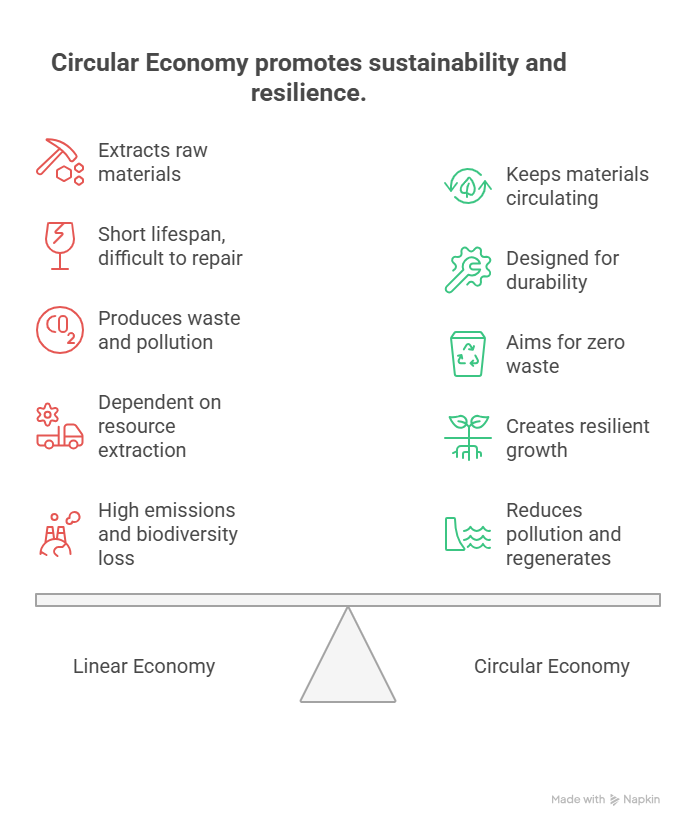
Below is a comparison table highlighting the fundamental differences between both models:
| Aspect | Linear Economy (Take Make Dispose) | Circular Economy (Reuse Repair Regenerate) |
|---|---|---|
| Resource Use | Extracts raw materials and discards after use | Keeps materials circulating through reuse and recycling |
| Product Design | Short lifespan, difficult to repair | Designed for durability, repairability, and recyclability |
| Waste Management | Produces waste and pollution | Aims for zero waste through closed loops |
| Economic Impact | Dependent on resource extraction | Creates resilient growth through innovation and efficiency |
| Environmental Outcome | High emissions and biodiversity loss | Reduces pollution and regenerates ecosystems |
Environmental, Economic, and Social Benefits of the Circular Economy
The advantages of a circular economy extend far beyond waste reduction they redefine how we measure growth and prosperity.
Environmental Benefits
- Lower greenhouse gas emissions: According to the United Nations Environment Programme (UNEP), nearly 50% of global emissions stem from raw material extraction and processing. Circular models can cut these drastically.
- Biodiversity protection: By minimizing resource extraction, circular practices safeguard forests, oceans, and natural habitats.
- Reduced pollution: Reusing and recycling limit landfill waste and water contamination.
Economic Benefits
- Resource efficiency and cost savings: The European Parliament estimates that circularity could save EU businesses up to €600 billion annually through material efficiency.
- New business models: From product as a service to remanufacturing, companies unlock value while minimizing input costs.
- Job creation: The World Economic Forum predicts millions of new green jobs in repair, recycling, and circular design sectors worldwide.
Social Benefits
- Healthier communities: Less pollution means improved air and water quality.
- Inclusive employment: Circular initiatives foster local economies through small scale repair shops and sustainable manufacturing.
- Consumer empowerment: Access to durable, repairable goods encourages mindful consumption and environmental awareness.
Applications Across Key Sectors
Textile Industry
Brands are embracing circular fashion through organic fibers, regenerative agriculture, and closed loop textile recycling systems that turn old garments into new fabrics.
Construction
Circular construction prioritizes reused materials, modular buildings, and low carbon alternatives like certified timber. Recycled aggregates replace virgin raw materials, cutting emissions and costs.
Electronics and Technology
Manufacturers adopt design for disassembly and device leasing models, extending product lifespans while recovering valuable metals for reuse.
Agro Industry and Renewable Energy
From biogas generation using organic waste to circular food chains, agriculture is becoming a leading force in sustainable resource loops.
Real World Examples of Circular Economy in Action
- Winnow (UK): AI powered tools that cut food waste in commercial kitchens by 50%, saving millions annually.
- DyeCoo (Netherlands): Uses CO₂ instead of water to dye fabrics recycling 100% of the gas used.
- Close the Loop (Australia): Converts printer cartridges and plastic waste into durable road asphalt.
- Enerkem (Canada): Transforms non recyclable municipal waste into biofuels and chemicals.
- Schneider Electric (France): Integrates recycled materials and offers product as a service models to extend lifecycle and reduce raw material consumption.
The Future of Circularity: Challenges and Opportunities
Governments, corporations, and consumers all play key roles in advancing circularity.
Policy and Regulation
- Global frameworks like the EU Circular Economy Action Plan and the UN Sustainable Development Goals (SDGs) are accelerating adoption.
- Key mechanisms include standards, incentives, and extended producer responsibility (EPR) laws.
Business and Innovation
- Enterprises investing in digital traceability, AI for waste analytics, and blockchain recycling systems will lead the next wave of circular innovation.
Toward a Regenerative Future
- The ultimate goal is a regenerative, low carbon economy.
- Growth benefits both people and the planet, creating prosperity without environmental compromise.
FAQs About the Circular Economy
What is the main goal of the circular economy?
To decouple economic growth from resource consumption by designing systems that eliminate waste.
How does the circular economy benefit businesses?
It reduces production costs, opens new revenue streams, and strengthens brand reputation through sustainability.
What can consumers do?
Opt for long lasting products, repair instead of replace, and support brands committed to circular principles.
Referencias
- Ellen MacArthur Foundation. (s. f.). What is the meaning of a circular economy and what are the main principles? https://ellenmacarthurfoundation.org/topics/circular-economy-introduction/overview
- Parlamento Europeo. (2023, 24 de mayo). Economía circular: definición, importancia y beneficios. europarl.europa.eu.
- Pino, C., Vásquez, M., Jácome, O., & Peña, R. (2024). Modelo de economía circular para los institutos técnicos y tecnológicos. Universidad, Ciencia y Tecnología, 28(125), 121–132. https://doi.org/10.47460/uct.v28i125.862
- Programa de las Naciones Unidas para el Desarrollo. (2023, 24 de abril). ¿Qué es la economía circular y por qué es importante? ClimatePromise. https://climatepromise.undp.org/es/news-and-stories/que-es-la-economia-circular-y-como-ayuda-a-combatir-el-cambio-climatico
- Foro Económico Mundial. (2019, 11 de marzo). Estas 11 empresas están liderando el camino de la economía circular. weforum.org.
- United States Environmental Protection Agency. (2025, 4 de septiembre). What is a circular economy? epa.gov.