Sustainable drainage also known as SuDS (Sustainable Urban Drainage Systems) isn’t just a new way to handle stormwater.
It’s a climate smart solution that prevents flooding, restores ecosystems, and turns cities into greener, healthier places to live.
In a world of rising urbanization and extreme weather, sustainable water management is no longer optional it’s essential.
What Is Sustainable Drainage?
SUDS drainage design mimics how nature manages rainwater.
Instead of sending water straight into drains and pipes (as traditional systems do), SuDS slow down, filter, and store rainfall where it lands.
Core Idea
SuDS are designed to reduce runoff, promote infiltration, and improve water quality before the water returns to the environment.
Common Components
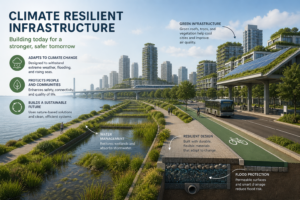
- Permeable pavements – allow rainwater to soak through surfaces.
- Rain gardens and green swales – collect and clean stormwater naturally.
- Constructed wetlands – trap and purify water through plants and soil.
- Retention basins – temporarily store excess rain during heavy storms.
In simple terms, sustainable drainage treats rain as a resource, not a nuisance.
Key Principles of SUDS drainage design
Every sustainable drainage system is built around four key principles:
- Infiltration – let water soak into the ground near where it falls.
- Retention – slow and store stormwater to prevent floods.
- Treatment – clean water naturally through vegetation and soil layers.
- Reuse – recycle collected rainwater for irrigation or recharge.
By restoring the natural water cycle disrupted by urban surfaces, SuDS reconnect cities with their hydrological balance.
Environmental and Social Benefits of SUDS drainage design
Environmental Benefits
- Flood prevention: reduces stormwater surges.
- Cleaner water: filters pollutants from runoff.
- Urban biodiversity: supports wildlife through green corridors.
- Lower heat island effect: cools cities through evaporation and vegetation.
Social & Economic Benefits
- Enhances urban aesthetics and livability.
- Cuts maintenance costs of traditional storm drains.
- Raises property value in green urban areas.
Studies show SuDS can reduce urban runoff pollution by up to 80% while making public spaces more attractive and resilient.
Sustainable Drainage Systems (SuDS): Step by Step Implementation Guide
Sustainable Urban Drainage Systems (SuDS) are stormwater management strategies that replicate the natural water cycle slowing, filtering, and reusing rainwater close to where it falls.
They reduce flooding, cut pollution, and enrich city life with green, multifunctional spaces. Globally, they are known as Water Sensitive Urban Design (Australia) or Low Impact Development (USA), but all share the same ecological principles.
1️⃣ Define Project Objectives
Start by setting clear local goals: flood control (quantity), water quality improvement, or urban enhancement.
Example: in flood prone areas, limit discharge rates during extreme rainfall.
Document objectives early to guide all design stages.
2️⃣ Site Characterization
Collect detailed climate, hydrology, soil, and land use data:
- Rainfall records and storm frequencies.
- Terrain slopes and natural drainage paths.
- Soil permeability and groundwater levels.
- Impervious vs. green areas.
Design tips:
- Preserve natural topography and permeable soils.
- Use existing green corridors for flow paths.
- Avoid deep excavations in high groundwater areas.
3️⃣Identify Siting Opportunities
Use gathered data to locate where SuDS can be installed:
- Roofs & streets → rain gardens or bioswales.
- Parks → underground storage tanks.
- Parking lots → permeable pavements.
Three management levels:
- Source control: green roofs, rain tanks.
- On site control: infiltration trenches, porous pavements.
- Regional control: detention ponds, wetlands.
4️⃣ Select Appropriate SuDS Techniques
Match SuDS types to site conditions:
- Infiltration systems: soakaways, gravel trenches (need permeable soils).
- Surface retention: ponds or wetlands (gentle slopes).
- Bioretention areas: vegetated filters and rain gardens.
- Permeable surfaces: porous asphalt or pavers.
Example: runoff from a car park can flow into a vegetated swale, then into a dry basin for controlled release.
5️⃣ Design and Sizing Calculations
- Estimate storage volumes and discharge rates using rainfall intensity–duration–frequency curves.
- Follow national standards (e.g., UK limit 3 L/s·ha).
- Ensure infiltration systems empty at least half their volume within 24 hours after a storm.
6️⃣ Construction and Implementation
- Construction sequence:
- Earthworks and gravel layers.
- Geotextiles and substrates.
- Vegetation planting.
Use native or flood tolerant species and test infiltration before commissioning.
Design paths or benches around ponds to add recreational value.
7️⃣ Maintenance and Monitoring
Plan long term maintenance:
- Remove debris and sediment.
- Replace failing vegetation.
- Inspect outlets and inlets annually or after major storms.
Assign responsibility early municipality, homeowners, or community groups.
8️⃣ Local Adaptation
Adapt designs to climate, terrain, and urban context:
- Arid zones: prioritize water harvesting and green roofs.
- Tropical regions: ensure high detention capacity.
- Cold climates: design for freeze thaw durability.
- Dense cities: use vertical or underground SuDS (e.g., sub base crates under parks).
Each SuDS project is unique tailor designs to local soil, space, and climate rather than copying templates.
Real World Examples of Sustainable Drainag
Around the world, Sustainable Drainage Systems (SuDS) have become key tools for resilient urban water management.
In China, the national “Sponge Cities” program integrates green infrastructure to absorb up to 70% of stormwater locally.
Australia’s WSUD (Water Sensitive Urban Design) approach blends landscape design and hydrology to manage rainfall sustainably.
In the United States, Low Impact Development (LID) projects have redefined stormwater control by promoting infiltration, reuse, and urban greening.
- London (UK): SuDS integrated into parks and housing developments.
- Copenhagen (Denmark): flood resilient parks that double as retention zones.
- Singapore: wetlands and smart sensors for water reuse.
- Zaragoza (Spain): permeable pavements and rain harvesting systems.
Across Europe and Spain, sustainable drainage is expanding rapidly. Cities like Barcelona, Valencia, and Seville now apply eco hydraulic engineering in new urban developments, using permeable pavements, bioswales, and constructed wetlands.
Regulation is also driving adoption:
- In the United Kingdom, DEFRA’s 2025 national SuDS standards set design and infiltration benchmarks to ensure consistent performance.
- In Latin America and Spain, several cities have issued technical SuDS guidelines, such as Murcia’s APIRM standards, promoting green infrastructure from planning to operation.
These initiatives confirm that SuDS must be integrated from early urban design stages through long term community management to achieve sustainable, climate resilient cities.
Challenges and Limitations
Despite the clear advantages, SuDS face several hurdles:
- Uneven regulation across regions.
- Higher upfront costs compared to conventional drainage.
- Need for regular maintenance and local expertise.
- Institutional inertia in replacing outdated systems.
Yet, over the long term, sustainable drainage saves money, reduces risk, and builds climate resilience.
The Future of Sustainable Drainage in Smart Cities
Next generation SuDS integrate with IoT sensors and data platforms to optimize water management in real time:
- Predict storms and adjust retention levels automatically.
- Monitor water quality continuously.
- Reduce irrigation and maintenance costs.
Sustainable drainage is rapidly becoming a pillar of smart, climate resilient cities and an essential part of green infrastructure planning.
Frequently Asked Questions (FAQs)
What’s the difference between sustainable and traditional drainage?
Traditional systems remove water fast; SuDS manage it naturally and beneficially.
Can SuDS be used at home?
Absolutely. Rain gardens, permeable driveways, and soakaways all work on small scales.
What materials are used?
Sand, gravel, native plants, and porous materials that filter water effectively.
Do SuDS require maintenance?
Yes mainly vegetation care and debris removal.
Are SuDS cost effective?
Yes. Long term savings and flood protection far outweigh initial investment.
📈 Conclusión
El drenaje sostenible es una herramienta esencial para construir ciudades resilientes, verdes y habitables.
Adoptar sistemas SUDS no solo protege el medio ambiente, sino que genera valor económico y social.
Cada metro cuadrado permeable cuenta: el futuro del agua urbana depende de cómo la dejemos fluir.
Referencias
Referencias (estilo APA, 7ª edición): Ayuntamiento de Murcia & Aguas de Murcia. (2023). Guía básica de diseño de Sistemas Urbanos de Drenaje Sostenible (SUDS) en el término municipal de Murcia. https://www.apirm.es/wp-content/uploads/2024/07/Guia-B%C3%A1sica-de-dise%C3%B1o-de-Sistemas-Urbanos-de-Drenaje-Sostenible-del-municipio-de-Murcia.pdf
Cheshire West and Chester Council. (2016). SuDS Guidance: Volume 1 – Design and technical guidance document (v4.0). https://www.cheshirewestandchester.gov.uk/asset-library/planning-policy/surface-water-management-and-sustainable-drainage/suds-volume-1-design-and-technical-guidance.pdf
Local Government Association. (2020). Sustainable drainage systems (SuDS). https://www.local.gov.uk/topics/severe-weather/flooding/sustainable-drainage-systems
Department for Environment, Food & Rural Affairs. (2025). National Standards for Sustainable Drainage Systems (SuDS). https://www.gov.uk/government/publications/national-standards-for-sustainable-drainage-systems-suds
California State Water Resources Control Board. (2013). Hydromodification LID Design Manual: The LID Site Design Process. https://www.waterboards.ca.gov/rwqcb3/water_issues/programs/stormwater/docs/lid/hydromod_lid_docs/steps_lid_design_expanded_.pdf