
What are biodiversity credits?
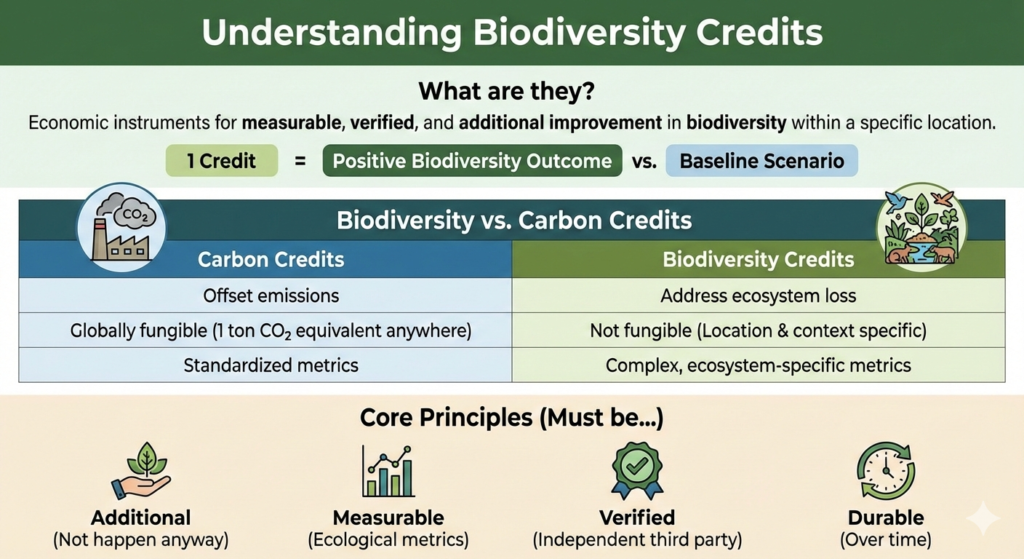
Biodiversity credits are economic instruments that represent a measurable, verified, and additional improvement in biodiversity within a specific location.
In simple terms:
1 biodiversity credit = a quantified positive biodiversity outcome compared to a baseline scenario.
Unlike carbon credits, biodiversity credits do not offset emissions. Instead, they address biodiversity loss, ecosystem degradation, and habitat decline, which are inherently local and context specific.
Biodiversity credits explained in simple terms
A biodiversity credit is issued only when a project can demonstrate that biodiversity is better than it would have been without the intervention. This improvement must be:
- Additional (it would not happen anyway),
- Measurable (using ecological metrics),
- Verified (by independent third parties),
- Durable over time.
What does “measurable and additional” really mean?
Projects must compare outcomes against:
- A baseline (current ecological state),
- A counterfactual scenario (what would happen without the project).
Only the net positive difference can generate biodiversity credits.
Why biodiversity credits exist
- The biodiversity funding gap: Global biodiversity continues to decline despite protected areas and conservation policies. Public funding alone is insufficient to halt ecosystem loss.
- The limits of public conservation budgets: Governments face structural budget constraints, while biodiversity loss is accelerating due to:
- Land use change,
- Pollution,
- Infrastructure expansion,
- Climate impacts.
- Why private capital is needed for nature: Biodiversity credits are designed to mobilize private investment toward conservation and restoration, integrating nature into economic decision making rather than treating it as an externality.
Comparative Table: Biodiversity Credits vs Carbon Credits
| Aspect | Carbon Credits | Biodiversity Credits |
|---|---|---|
| Fungibility | Carbon is globally fungible: one ton of CO₂ is equivalent anywhere in the world. | Biodiversity is not fungible and cannot be exchanged on a like for like basis. |
| Ecological equivalence | Emission reductions can be compensated in any location. | A wetland, coral reef, or old-growth forest cannot be replaced by an equivalent ecosystem elsewhere. |
| Context dependence | Carbon value is location independent. | Biodiversity value depends on location, species composition, ecological functions, and cultural and social context. |
| Market logic | Based on standardized and simple metrics. | Requires complex, ecosystem-specific metrics. |
| Risks of applying carbon logic | Low, due to global uniformity of carbon emissions. | Applying carbon market logic to biodiversity risks oversimplification, poor ecological outcomes, and loss of irreplaceable ecosystems. |
What can be issued as a biodiversity credit?
- Ecosystem restoration projects
- Forest restoration,
- Wetland recovery,
- Grassland regeneration.
- Habitat conservation and connectivity
- Protection of critical habitats,
- Creation of ecological corridors,
- Reduction of fragmentation.
- Species focused interventions
- Recovery of threatened species,
- Improvement of breeding or feeding grounds.
- Reduction of human pressures on ecosystems
- Limiting land use intensity,
- Reducing pollution sources,
- Improving land and water management practices.
The relationship between biodiversity credits and pollution reduction
Why reducing pollution is a prerequisite for biodiversity gains
Biodiversity cannot recover in polluted environments.
Reducing contamination is often a condition for biodiversity credits to exist.
Pollution sources addressed by biodiversity credit projects
- Industrial and agricultural runoff,
- Excessive agrochemical use,
- Emissions affecting sensitive ecosystems,
- Untreated wastewater discharges.
Restoration actions that reduce contamination indirectly
- Soil restoration improving filtration,
- Wetland recovery purifying water bodies,
- Reforestation reducing sediment and chemical loads.
👉 Less pollution increases ecosystem viability, enabling measurable biodiversity improvements.
Biodiversity credits and environmental degradation
Degradation, habitat fragmentation and ecosystem decline
Environmental degradation includes:
- Soil quality loss,
- Habitat fragmentation,
- Altered ecological cycles.
Financing ecosystem restoration and ecological recovery
Biodiversity credits fund:
- Active ecological restoration,
- Reconnection of biological corridors,
- Recovery of ecosystem functions.
Why credits require demonstrable improvement, not passive conservation
Credits demand measurable positive change, not merely avoiding damage.
Voluntary and regulated biodiversity credit markets
Voluntary markets and ESG driven demand
Companies purchase biodiversity credits to:
- Strengthen ESG strategies,
- Demonstrate nature-positive commitments,
- Address investor and stakeholder expectations.
Regulated markets and legal biodiversity obligations
Some jurisdictions mandate biodiversity outcomes:
- Biodiversity Net Gain (UK),
- No Net Loss frameworks.
No Net Loss and Net Gain frameworks
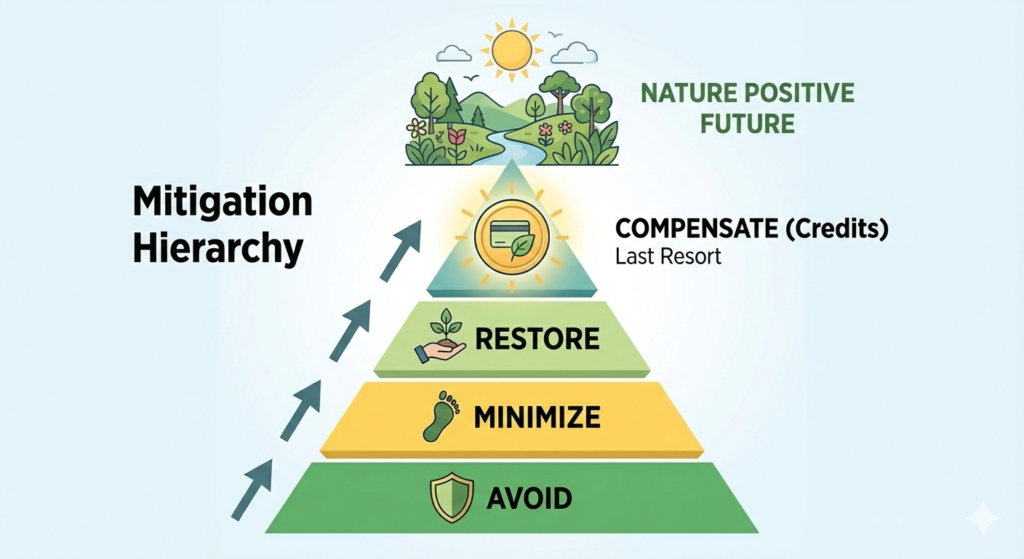
Credits are often used only when on-site mitigation is not possible, respecting the mitigation hierarchy.
Examples and country experiences
- United Kingdom and Biodiversity Net Gain: Developers must deliver at least 10% biodiversity net gain, with credits as a last resort.
- Australia’s biodiversity offset schemes: One of the most advanced regulated biodiversity credit systems globally.
- Global initiatives and pilot programs:
- World Economic Forum initiatives,
- Biodiversity Credit Alliance,
- TNFD-aligned frameworks.
How biodiversity credits are measured
Baselines and counterfactual scenarios
Measurement compares:
- Current conditions,
- Expected degradation without intervention.
Biodiversity metrics and ecological indicators
- Species richness and abundance,
- Habitat condition scores,
- Ecosystem integrity indices.
Monitoring, verification and long term tracking
Credits require continuous monitoring, often over decades.
Verification, standards and governance
Who certifies biodiversity credits?
- Independent auditors,
- NGOs,
- Government agencies.
Key principles: additionality, permanence and transparency
Without these, credits lose credibility.
The role of independent auditors and institutions
Third party oversight is essential to avoid greenwashing.
Who buys biodiversity credits and why
Compliance driven demand
- Infrastructure,
- Extractive industries,
- Energy and transport projects.
Corporate sustainability and ESG strategies
- Multinationals,
- Financial institutions,
- Nature positive pledges.
Risk management and reputational factors
Credits help manage regulatory, reputational, and transition risks.
Biodiversity credits as a tool for sustainability
- Environmental sustainability and natural capital protection: They protect ecosystems that deliver essential services.
- Economic sustainability and private investment: They unlock new nature based financial markets.
- Social sustainability and community benefits:
- Green jobs,
- Local income,
- Recognition of land stewardship.
👉 Biodiversity becomes an asset to conserve, not a barrier to development.
Biodiversity credits and environmental protection policies
Complementing protected areas and conservation laws
Credits strengthen not replace traditional protection.
Strengthening the mitigation hierarchy
- Avoid impacts
- Minimize
- Restore
- Compensate (credits)
Linking environmental protection to financial responsibility
Environmental damage carries economic consequences.
Benefits of biodiversity credits
- Environmental benefits
- Ecosystem restoration,
- Species recovery,
- Increased resilience.
- Economic benefits
- Private capital mobilization,
- Reduced public costs,
- Innovation in green finance.
- Social and territorial benefits
- Local employment,
- Sustainable land use,
- Community participation.
Criticisms, risks and limitations
- Greenwashing and weak metrics: Poor standards undermine credibility.
- Irreversible biodiversity loss: Some impacts cannot be compensated.
- Ethical and social concerns: Land rights and community displacement risks must be addressed.
Biodiversity credits and Environmental Impact Assessment (EIA)
The mitigation hierarchy in practice
Credits are a last resort, not a license to destroy.
When biodiversity credits should and should not be used
They complement EIA processes but do not replace prevention.