What Is Carbon Management Software
Carbon management software is no longer a niche sustainability tool, it has become strategic infrastructure for enterprises. Modern solutions allow businesses to measure, track, and reduce greenhouse gas (GHG) emissions across Scope 1, 2, and the complex Scope 3 categories, ensuring regulatory compliance with frameworks like CSRD, ISSB, and SEC climate disclosure rules.
From Carbon Accounting to Full Carbon Management Strategy
Traditional carbon accounting focuses on measuring emissions, but carbon management software transforms this into actionable strategies. Enterprises can now integrate emissions data into financial decisions, decarbonization plans, and operational dashboards.
Why Scope 3 Is Driving Software Spend
Scope 3 emissions from suppliers, logistics, and product use , often account for 70–90% of a company’s total carbon footprint. Solutions like Sweep Carbon Management and Persefoni provide automated Scope 3 tracking, scenario analysis, and supplier engagement tools that save time and reduce errors.
You might be interested: carbon footprint
The Compliance Wave: CSRD, ISSB, SEC & Global Disclosure
With mandatory climate reporting increasing worldwide, companies need platforms that deliver audit ready reporting. Enterprise carbon management platforms now combine compliance with operational insights, making them indispensable for financial decision makers.
You might be interested: Best Enterprise Carbon Reporting Software in 2026
Top Carbon Management Platforms Compared
Based on Scope coverage, compliance readiness, AI integration, and enterprise adoption, the following are the top-performing carbon management platforms.
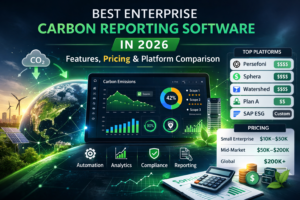
| Platform | Scope Coverage | Scope 3 Depth | AI & Analytics | ERP Integration | Compliance Strength | Best For | Price Tier |
|---|---|---|---|---|---|---|---|
| Sweep | 1, 2, 3 | High | Forecasting & scenario analysis | Moderate | CSRD/SFDR-ready | Large enterprises | $$ |
| Persefoni | 1, 2, 3 | High | AI-driven analytics, PersefoniGPT | Strong | Audit-ready, US/EU compliance | Finance & corporate | $$$ |
| Watershed | 1, 2, 3 | Medium | Pathway modeling | Moderate | SEC & EU-ready | Medium & large businesses | $$ |
| Terrascope | 1, 2, 3 | High | AI recommendations, compensation planning | Moderate | EU compliance-ready | Supply chain-heavy companies | $$ |
| Normative | 1, 2, 3 | High | Spend & activity-based modeling | Moderate | CSRD, EU rules | Large enterprises, complex chains | $$ |
| Microsoft Sustainability Cloud | 1, 2, 3 | Medium | Power BI integration, analytics | Strong | CSRD-ready | Global enterprises | $$$ |
| IBM Envizi | 1, 2, 3 | Medium | Climate intelligence & predictions | Strong | US/EU compliance | Complex infrastructure | $$$ |
| SAP Sustainability Control Tower | 1, 2, 3 | Medium | Data management & BI | Strong | Multi-framework compliance | Enterprise | $$$$ |
| Salesforce Net Zero Cloud | 1, 2, 3 | Medium | Integrated CRM & ESG workflows | Strong | CSRD/ESRS | Enterprise with Salesforce ecosystem | $$$ |
| Sphera | 1, 2, 3 | Medium | Scenario modeling & analytics | Moderate | Regulatory coverage | Heavy industries | $$$$ |
Carbon First vs ESG Platform: Which Delivers Better ROI?
Enterprises often face a choice:
- Carbon-first platforms: Best for precision in Scope 3, AI-driven forecasting, and decarbonization modeling.
- Broader ESG suites: Ideal for companies that want carbon reporting as part of a full sustainability ecosystem integrated with ERP and financial systems.
Hybrid approach: Many enterprises combine carbon-first solutions for operational accuracy with ESG suites for investor-ready reporting.
Audit Readiness & Investor Reporting
Platforms like Persefoni and Watershed provide AI-enhanced, audit-ready reporting to satisfy investors and regulators — a key factor for high CPC keywords.
How to Build a High Impact Carbon Management Strategy
To maximize ROI from carbon management software:
Scope 1–3 Data Architecture
Centralize emissions data from all sources, including energy use, transport, and suppliers.
Supplier Engagement & Value Chain Visibility
Engage suppliers directly through Sweep Carbon Management or Normative to ensure accurate Scope 3 reporting.
Decarbonization Modeling & Scenario Planning
Use AI powered scenario planning to forecast emissions reduction and model carbon cap management strategies.
Carbon Cap Management & Regulatory Controls
Integrate energy & carbon management systems with regulatory frameworks to achieve compliance and efficiency.
Integrating Energy & Carbon Management Systems
Connect energy usage and carbon emissions data into a single dashboard for real-time insights.
How Much Does Carbon Management Software Cost in 2026?
- Small businesses / SME: <$50K/year (starter packages, limited Scope 3)
- Mid-market: $50K–150K/year (Scope 3, supplier engagement, basic AI modeling)
- Enterprise: $150K–300K/year (audit-ready, AI-driven, investor-grade)
- Global ESG suites: $300K+/year (full ERP & multi-framework integration)
How to Choose the Right Carbon Management Platform
Industry
- Finance: Persefoni, Normative
- Manufacturing & Heavy Industry: SAP, IBM, Sphera
- Retail & Consumer Brands: Sweep, Watershed, Salesforce
By Regulatory Exposure
- Europe (CSRD/ESRS): Sweep, Terrascope, Microsoft
- US & Global SEC rules: Watershed, Persefoni, IBM
By Supply Chain Complexity
- Complex chains → Normative, Terrascope, Sweep
- Simple chains → Greenly, SME-tier packages
Conclusion
Carbon management software is now critical enterprise infrastructure, not just a sustainability tool. By integrating Scope 3 insights, AI modeling, and regulatory compliance, companies convert carbon management into strategic advantage, ROI, and investor confidence.