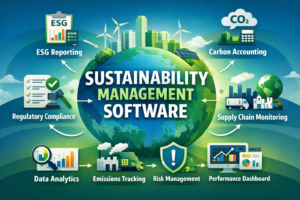
ESG reporting software companies is a critical enterprise platform that helps organizations collect, manage, and report Environmental, Social, and Governance (ESG) data in compliance with global regulations. With frameworks like CSRD (EU), SEC (US), GHG Protocol, GRI, and SASB, companies are now required to:
- Track carbon emissions (Scope 1, 2, 3)
- Report sustainability metrics
- Ensure regulatory compliance
- Provide transparent data to investors
This is no longer optional, it’s a core business requirement for enterprise companies.
From an enterprise perspective, ESG platforms are tightly connected to:
- Financial reporting systems
- Risk management frameworks
- Corporate governance strategies
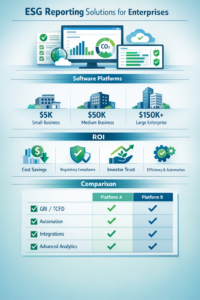
ESG Software Comparison Table
| Platform | Best For | Pricing | Key Feature | Compliance |
|---|---|---|---|---|
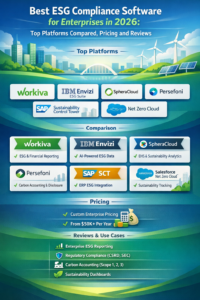
| Workiva | Enterprise corporations | Custom | ESG + financial reporting | SEC, GRI |
| Tanso | Manufacturing | Custom | AI-driven CSRD reporting | CSRD, ESRS |
| Novisto | Private equity | Custom | ESG data automation | GRI, SASB |
| Watershed | Climate-focused companies | Custom | Scope 1–3 tracking | CSRD, Paris |
| Microsoft Sustainability Manager | Microsoft ecosystem | Azure-based | AI + cloud integration | GRI, SASB |
Recommended: Best ESG Reporting Software for SEC and CSRD Compliance in 2026
Key Features to Look for in ESG Reporting Platforms
Choosing the right ESG software platform requires evaluating both technical capabilities and regulatory alignment.
Data Automation and AI Insights
Modern ESG tools automate:
- Data collection across departments
- Supplier and supply chain inputs
- Real-time ESG metrics
This reduces manual reporting errors and improves audit readiness.
Regulatory Compliance (CSRD, SEC, GRI, SASB)
Top-tier platforms support:
- CSRD and ESRS (Europe)
- SEC climate disclosures (US)
- GRI / SASB frameworks
👉 This is essential for companies operating in multi-jurisdictional environments.
Enterprise Integrations (ERP, CRM, Cloud)
Best ESG platforms integrate with:
- SAP
- Microsoft Azure
- ERP and CRM systems
This ensures centralized data governance and scalability.
Carbon Accounting & Scope 1–3 Tracking
Advanced tools include:
- Net-zero planning
- Emissions tracking
- Climate scenario modeling
Top ESG Reporting Software Companies
Workiva
Best for: Enterprise corporations needing unified ESG + financial reporting
Pricing: Custom enterprise pricing
Pros
- Integrated ESG + financial platform
- Advanced XBRL reporting
- Real-time collaboration
Cons
- High cost
- Complex onboarding
Key Features
- Custom dashboards
- ERP/CRM integrations
- Enterprise-grade compliance
👉 Ideal for organizations already investing in enterprise reporting and compliance ecosystems.
Tanso
Best for: Mid-sized manufacturing and supply chain-heavy companies
Pricing: Custom (mid-market)
Pros
- AI-driven ESG data management
- Strong CSRD / ESRS capabilities
- SAP/Dynamics integration
Cons
- Less global brand recognition
Key Features
- Audit trails
- Multi-framework reporting
👉 Strong choice for European companies adapting to CSRD regulations.
Novisto
Best for: Private equity, VC-backed companies, and corporates
Pricing: Custom
Pros
- ESG data automation
- Strong reporting workflows
- Recognized by analysts
Cons
- Less focused on carbon-specific analytics
Key Features
- GRI / SASB frameworks
- ESG performance tracking
👉 Particularly valuable for firms focused on investor-grade ESG reporting.
Watershed
Best for: Climate-focused enterprises
Pricing: Custom enterprise
Pros
- Scope 1–3 emissions tracking
- Climate reduction planning
- Alignment with Paris Agreement
Cons
- Limited governance/social features
Key Features
- Carbon analytics
- Climate strategy tools
👉 Ideal for companies prioritizing decarbonization strategies.
Microsoft Sustainability Manager
Best for: Companies using Microsoft ecosystem
Pricing: Azure-based subscription
Pros
- Native Microsoft integration
- AI-powered insights
- Scalable cloud infrastructure
Cons
- Dependency on Microsoft stack
Key Features
- ESG dashboards
- GRI/SASB reporting
👉 Best option for organizations already leveraging Microsoft enterprise solutions.
Which Platform Is Best?
Workiva vs Novisto
- Workiva → stronger financial integration
- Novisto → better for ESG-specific workflows
Tanso vs Microsoft Sustainability Manager
- Tanso → better CSRD specialization
- Microsoft → better ecosystem integration
Watershed vs Tanso
- Watershed → climate-focused
- Tanso → broader ESG compliance
How to Choose the Right ESG Reporting Software
Company Size
- Enterprise → Workiva, Microsoft
- Mid-market → Tanso
- Investment firms → Novisto
Regulatory Needs
- EU (CSRD) → Tanso, Watershed
- US (SEC) → Workiva
Based on Pricing
- Enterprise → custom pricing models
- Cloud-based → subscription (Microsoft)
Based on Tech Stack
- SAP users → Tanso
- Microsoft users → Sustainability Manager
Benefits of ESG Reporting Software companies
- Improved regulatory compliance
- Better investor transparency
- Enhanced operational efficiency
- Stronger brand reputation
ESG platforms are now directly tied to enterprise valuation and access to capital.
Common Challenges and Limitations
- High implementation cost
- Data complexity
- Internal adoption barriers
Companies should align ESG strategy with IT and finance teams early.
Choosing the Right ESG Platform
Selecting the right ESG reporting software is no longer just a compliance decision, it’s a strategic investment in enterprise resilience and growth.
Companies that adopt the right platform can:
- Reduce regulatory risk
- Improve operational transparency
- Gain competitive advantage
👉 The best choice depends on your:
- Industry
- Regulatory exposure
- Technology ecosystem
FAQs
What is ESG reporting software?
A platform that helps companies track, manage, and report ESG data in compliance with global standards.
How much does ESG software cost?
Most enterprise solutions use custom pricing, starting around €3,000/year for smaller companies.
Which ESG platform is best for enterprises?
Workiva and Microsoft Sustainability Manager are leading options.
Is ESG reporting mandatory?
Yes, in many regions (e.g., CSRD in Europe, SEC proposals in the US).
What frameworks do ESG tools support?
GRI, SASB, CSRD, ESRS, and GHG Protocol.
How long does implementation take?
Typically 3–12 months depending on complexity.
Can small businesses use ESG software?
Yes, but most solutions are optimized for mid-market and enterprise.