Blue carbon is no longer just an environmental concept. It has become a strategic pillar in climate mitigation, biodiversity protection, and carbon markets.
In this guide, you’ll learn:
- What blue carbon really means scientifically
- How ecosystems like mangroves outperform many tropical forests in CO₂ storage
- The role of the Blue Carbon Initiative in global policy
- How blue carbon connects to climate finance, MRV systems, and carbon credits
- The real global mitigation potential (with comparative charts)
What Is Blue Carbon?
Blue carbon refers to organic carbon captured, fixed, and stored long term in vegetated coastal and marine ecosystems, primarily:
- Mangroves
- Salt marshes
- Seagrass meadows
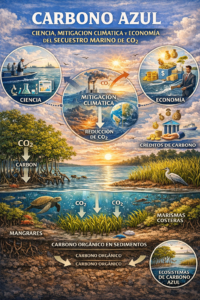
Unlike terrestrial forests, the majority of blue carbon is stored not in trees, but in water saturated, oxygen poor marine sediments.
These anoxic sediments dramatically slow microbial decomposition, allowing carbon to remain buried for centuries to millennia.
This is what makes blue carbon ecosystems among the most powerful natural carbon sinks on Earth
How Blue Carbon Works: The Biogeochemical Process
The carbon sequestration process follows a clear pathway:
- Photosynthesis captures atmospheric CO₂
- Carbon is transferred to plant biomass (above and below ground)
- Organic detritus accumulates
- Carbon becomes buried in anoxic sediments
- Mineralization occurs extremely slowly
The key scientific advantage:
Low oxygen = reduced microbial breakdown = long term storage.
Blue Carbon vs. Terrestrial Carbon Capture
While forests store carbon mainly in biomass, coastal ecosystems store most carbon underground.
| Feature | Tropical Forests | Blue Carbon Ecosystems |
|---|---|---|
| Main storage | Biomass | Sediments |
| Oxygen levels | Aerobic | Anoxic |
| Decomposition rate | Moderate | Very slow |
| Storage duration | Decades–centuries | Centuries–millennia |
This sediment based storage makes blue carbon particularly durable.
Comparative Capture Rates: Scientific Data Visualization
Below are capture rates in metric tons of CO₂ equivalent per hectare per year (tCO₂e/ha/year):
Carbon Sequestration by Ecosystem Type
| Ecosystem Type | Annual Capture Rate (tCO₂e/ha/year) | Storage Mechanism | Relative Efficiency |
|---|---|---|---|
| Mangroves | 6 – 8 | Deep anoxic sediments | Very High |
| Salt Marshes | 2 – 6 | Waterlogged soils | High |
| Seagrass Meadows | 1 – 4 | Marine sediment burial | Moderate |
Average Comparative Graph
| Ecosystem Type | Mean Capture Rate (tCO₂e/ha/year) |
|---|---|
| Mangroves | ~7 |
| Salt Marshes | ~4 |
| Seagrasses | ~2.5 |
Origins of the Blue Carbon Concept
The term gained global recognition in 2009 with the report:
«Blue Carbon: The Role of Healthy Oceans in Binding Carbon»
Published by:
- UNEP
- FAO
- UNESCO
However, scientific groundwork began decades earlier:
- 1970s–1980s: Coastal sedimentology studies
- 1990s: Mangrove carbon density research
- 2000–2008: Isotopic geochemistry confirmed millennial storage
The term was strategically introduced to integrate coastal ecosystems into climate policy frameworks.
Types of Blue Carbon
1. Classical Coastal Blue Carbon
- Mangroves
- Salt marshes
- Seagrasses
2. Emerging Blue Carbon
- Kelp forests
- Exported macroalgae
- Continental shelf sediments
3. Deep Blue Carbon (Research Hypothesis)
- Burial in deep ocean basins
- Lateral transport of particulate carbon
This emerging field may redefine global ocean carbon budgets.
Why Blue Carbon Matters for Climate Change
Despite covering less than 2% of the ocean surface, blue carbon ecosystems:
- Account for up to 50% of carbon buried in coastal marine sediments
- Store carbon for millennia
- Provide permanent mitigation potential
When degraded, they release:
- CO₂
- Methane (CH₄)
Destruction turns a carbon sink into a carbon source.
Blue Carbon Initiative & Global Programs
The leading global platform is:
- Blue Carbon Initiative
It supports integrating blue carbon into climate policy and national commitments.
Other major actors:
- International Partnership for Blue Carbon
- Conservation International
- The Nature Conservancy
These organizations help embed blue carbon into NDCs (Nationally Determined Contributions).
Blue Carbon and Climate Finance
Blue carbon projects now connect to voluntary carbon markets.
Standards
- Verra (VM0033 coastal wetlands methodology)
- Gold Standard coastal wetland methodology
MRV Technologies (Measurement, Reporting & Verification)
Leading companies involved in satellite and monitoring systems:
- Planet Labs
- Sylvera
Technologies include:
- LiDAR sensing
- GIS modeling
- Sediment core sampling
- δ13C isotopic analysis
- Blockchain for credit traceability
Blue carbon is increasingly discussed alongside initiatives like blue planet carbon capture and blue source carbon project development.
Environmental Co-Benefits Beyond Carbon
Blue carbon ecosystems also provide:
- Storm surge protection
- Coastal erosion reduction
- Nutrient filtration
- Fisheries enhancement
- Biodiversity conservation
This multi-benefit profile strengthens their commercial and policy appeal.
Scientific Limitations and Risks
Despite strong potential, challenges remain:
- High spatial variability
- Uncertainty in deep ocean export
- Sea-level rise impacts
- Double-counting risks in carbon markets
These factors demand robust MRV frameworks.
Global Mitigation Potential
Scientific estimates suggest:
0.5 – 1.4 GtCO₂e per year global mitigation potential.
Mangrove restoration alone could offset up to 10% of annual AFOLU sector emissions in tropical countries.
This positions blue carbon as a high-impact natural climate solution.
Conclusion: Why Blue Carbon Is a Strategic Climate Asset
Blue carbon sits at the intersection of:
- Climate science
- Coastal ecology
- Carbon finance
- Biodiversity policy
Its sediment based storage mechanism provides long term durability unmatched by many terrestrial systems.
As climate markets evolve, blue carbon projects may become one of the most strategically valuable natural climate solutions available.
FAQs
Is blue carbon better than forest carbon?
In many cases, yes, especially in terms of long term sediment storage and per hectare efficiency (particularly mangroves).
Can blue carbon generate carbon credits?
Yes, through verified standards like Verra and Gold Standard methodologies.
Is blue carbon permanent?
It can be stored for millennia, but only if ecosystems remain intact.