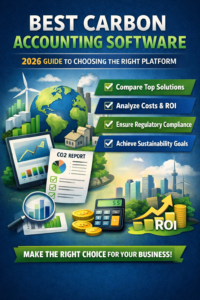
Carbon accounting software is no longer optional. For companies operating in the US, UK, Canada, Europe, Australia and America; measuring and reporting greenhouse gas emissions is now a strategic, regulatory, and financial priority.
The right carbon accounting software does far more than calculate emissions. It enables:
- Scope 1, 2, and 3 tracking
- Regulatory compliance (CSRD, SEC, SBTi, PCAF)
- Audit-ready carbon reporting
- Supplier engagement and value chain modeling
- Enterprise-grade emissions management
But not all carbon management software is built the same. Pricing, depth of Scope 3 modeling, industry specialization, and enterprise integrations vary dramatically.
What Is Carbon Accounting Software?
Is a digital platform that helps businesses measure, manage, and report their greenhouse gas (GHG) emissions across:
- Scope 1: Direct operational emissions
- Scope 2: Purchased energy emissions
- Scope 3: Indirect value chain emissions
Unlike a basic carbon calculator, enterprise carbon accounting software supports:
- Automated data ingestion
- Emission factor databases
- Audit documentation
- Compliance reporting frameworks
- Advanced Scope 3 modeling
This is why many companies are shifting from spreadsheets to full carbon accounting platforms.
Carbon Accounting Software vs Carbon Reporting Software
While often used interchangeably:
- Carbon accounting software calculates and manages emissions data.
- Carbon reporting software focuses on disclosure and compliance output.
Modern enterprise solutions combine both into an integrated carbon management system.
Carbon Accounting vs Lifecycle Assessment (LCA)
Corporate carbon accounting measures emissions at the company level.
Lifecycle assessment (LCA) evaluates the environmental footprint of a specific product from raw material to end-of-life.
Some specialized platforms integrate both approaches, especially in food, fashion, and manufacturing industries.
Why Carbon Accounting Software Is Now Business-Critical
Fas become a core business infrastructure investment, not just a sustainability initiative.
Regulatory Pressure
Organizations face increasing disclosure requirements, including:
- CSRD (Europe)
- SEC climate disclosure rules (US)
- SBTi target validation
- PCAF standards for financial institutions
Without structured carbon accounting software, compliance becomes high risk and resource intensive.
Investor and Supply Chain Demands
Investors increasingly require granular, auditable emissions data.
Large enterprises now require suppliers to disclose Scope 3 emissions as part of procurement processes.
Carbon accounting software enables companies to:
- Maintain audit-ready carbon data
- Improve tender eligibility
- Strengthen ESG reporting credibility
Financial Impact: Revenue, Cost & Risk
Companies using enterprise carbon accounting software can:
- Improve eligibility for ESG-sensitive contracts
- Reduce operational costs through emissions optimization
- Avoid greenwashing risk
- Mitigate supply chain climate exposure
For many businesses, carbon management software directly impacts revenue and risk mitigation.
Carbon Accounting Software Pricing (2026 Breakdown)
One of the most searched queries is:
“How much does carbon accounting software cost?”
Pricing varies significantly by company size, Scope 3 complexity, and compliance needs.
| Platform | Best For | Company Size | Scope 3 Depth | Compliance Support | Estimated Annual Pricing | Main Markets |
|---|---|---|---|---|---|---|
| Normative | Audit-ready enterprise reporting | Mid–Enterprise | Advanced (Value Chain + Supplier Network) | CSRD, SBTi, GHG Protocol | Custom Quote (Typically Enterprise-Level) | US, Europe |
| Persefoni | Financial services & global enterprises | Small–Enterprise | Advanced (Portfolio + Supplier Portal) | PCAF, SEC, CSRD | Free Tier → $50,000+ | Global |
| Watershed | Large enterprises & tech companies | Mid–Enterprise | Advanced (Scenario Modeling) | CDP, SEC, CSRD | ~$50,000 – $250,000+ | US, UK |
| Greenly | SMEs & mid-market (EU-focused) | Small–Mid | Moderate | CSRD (EU), ESG frameworks | ~$3,000 – $25,000 | Europe, US |
| CarbonZE | Small organizations | Small–Mid | Basic–Moderate | Standard GHG reporting | ~$3,000 – $7,000 | Europe |
| Plan A | CSRD-driven EU mid-market | Mid–Enterprise | Advanced | CSRD Specialist | ~$30,000 – $200,000 | Europe |
| IBM | Complex multinational enterprises | Enterprise | Advanced (Multi-Entity) | Global Regulatory | ~$30,000 – $150,000+ | Global |
| Salesforce | Salesforce ecosystem users | Mid–Enterprise | Moderate–Advanced | ESG + Compliance | ~$75,000 – $250,000+ | Global |
Pricing Comparison by Company Size
Small Businesses (1–50 employees)
| Platform | Typical Cost | Why Choose It |
|---|---|---|
| Greenly | $3K–12K/year | Fast onboarding, cost-effective |
| CarbonZE | $3K–7K/year | Transparent pricing |
| Persefoni (Free Tier) | Free | Basic footprint tracking |
Mid Market (50–250 employees)
| Platform | Typical Cost | Strength |
|---|---|---|
| Plan A | $30K+/year | Strong CSRD compliance |
| Persefoni Advanced | $50K+/year | Global portfolio analytics |
| Watershed | $40K–150K/year | Scenario modeling & reporting |
Enterprise (250+ employees)
| Platform | Typical Cost | Key Advantage |
|---|---|---|
| Watershed | $50K–250K+ | Enterprise automation |
| Normative | Custom | Audit-ready, science-backed |
| IBM Envizi | $30K–150K+ | Complex multi-site operations |
| Salesforce Net Zero Cloud | $75K–250K+ | Native Salesforce integration |
Small Businesses (1–50 Employees)
Typical Budget: $3,000 – $12,000 per year
Best-fit platforms:
- Greenly
- CarbonZE (SME-focused solution)
- Persefoni free tier
Greenly offers pricing starting from approximately €300 annually for very basic plans and scaling up depending on features.
CarbonZE publishes transparent pricing from ~$3,000 to ~$7,000 annually.
These platforms are ideal for:
- Early-stage ESG reporting
- Basic Scope 1 and 2 tracking
- Light Scope 3 reporting
Mid-Market Companies (50–250 Employees)
Typical Budget: $15,000 – $80,000 per year
Best-fit platforms:
- Plan A
- Persefoni (Advanced)
- Coolset
At this stage, businesses require:
- Full Scope 3 modeling
- Supplier engagement tools
- CSRD alignment
- Audit documentation
Enterprise Organizations (250+ Employees)
Typical Budget: $50,000 – $250,000+ per year
Leading enterprise carbon accounting platforms:
- Watershed
- Normative
- IBM
- Salesforce
Enterprise carbon accounting software typically includes:
- Deep Scope 3 value chain modeling
- ERP integrations
- Audit-ready infrastructure
- Multi-entity reporting
- Advanced AI-powered anomaly detection
Large organizations should expect customized pricing based on data volume and integration needs.
Why Most Vendors Don’t Publish Pricing
Pricing often depends on:
- Number of entities
- Geographic footprint
- Scope 3 data complexity
- Integration requirements
- Level of consulting support
This is why many vendors require a demo and custom quote.
Best Carbon Accounting Software by Company Size
Best for Small Businesses
- Greenly — Cost-effective, EU-focused, fast onboarding
- CarbonZE — Transparent pricing and SME-friendly structure
These tools are ideal for startups and small organizations beginning their carbon reporting journey.
Best for Mid-Market Companies
- Plan A — Strong CSRD specialization
- Persefoni — Growing mid-market adoption
- Coolset — Modular and flexible
Best for Enterprises
- Watershed — Strong scenario modeling and enterprise usability
- Normative — Audit-ready, science-based foundation
- IBM Envizi — Deep integration across complex operations
- Salesforce Net Zero Cloud — Ideal for Salesforce ecosystem users
Enterprise carbon management software prioritizes compliance, scalability, and data integrit
Best Carbon Accounting Software by Industry
Food & FMCG
Carbon Maps specializes in:
- Ingredient-level modeling
- Agricultural emissions tracking
- Product carbon footprint calculations
This is critical where Scope 3 dominates total emissions
Fashion & Apparel
Carbonfact focuses on:
- Material-level emissions
- Supplier integration
- Product lifecycle tracking
Fashion brands often see 80–95% of emissions in Scope 3
Financial Services
Persefoni provides portfolio level analytics aligned with PCAF standards.
Banks and asset managers require financed emissions tracking rather than operational-only reporting.
Industrial & Manufacturing
Sphera offers:
- Operational emissions tracking
- EHS integration
- Lifecycle assessment tools
Real Estate & Construction
Deepki supports:
- Portfolio-level emissions
- Building performance analytics
- Regulatory reporting
Real estate combines operational and embodied carbon challenges.
How to Choose the Right Carbon Accounting Software
When evaluating carbon accounting software vendors, ask:
- Is the platform aligned with the GHG Protocol?
- How often are emission factors updated?
- Does it support spend-based and activity-based data?
- Can it handle full Scope 3 modeling?
- Is documentation audit-ready?
- Does it integrate with ERP systems?
Choosing the wrong carbon management software can lead to:
- Inaccurate emissions baselines
- Compliance risk
- Greenwashing exposure
- Wasted implementation budget
You may be interested: Best Carbon Accounting Software in 2026
Carbon Accounting Software FAQs
What is the best carbon accounting software overall?
There is no universal best platform. The right carbon accounting software depends on company size, industry, compliance requirements, and Scope 3 complexity.
How much does carbon accounting software cost?
Small business solutions start around $3,000 annually. Enterprise platforms can exceed $200,000 per year depending on scope and integration.
Do small companies need Scope 3 tracking?
If they sell to enterprise customers or operate in supply-chain-heavy industries, yes. Scope 3 emissions often represent the majority of total impact.
How long does implementation take?
Implementation ranges from a few weeks for SMEs to several months for enterprise deployments with ERP integration.
Conclusion
Carbon accounting software is becoming foundational business infrastructure.
Organizations that invest in the right carbon management software gain:
- Regulatory resilience
- Investor confidence
- Supply chain credibility
- Strategic emissions visibility
The key is aligning platform capability with your company’s size, industry, and compliance exposure.