Carbon removal credits are rapidly becoming the most strategic asset in the voluntary carbon market. As scrutiny around carbon offsets increases and net-zero commitments tighten, companies are shifting toward high-integrity carbon removal credits that deliver measurable, durable climate impact.
But what exactly are carbon removal credits? How do they differ from carbon reduction or avoidance credits? Why are they more expensive? And why are companies like Microsoft and Google committing billions to them?
What Are Carbon Removal Credits?
A carbon removal credit represents the verified removal of one metric ton of CO₂ (or CO₂e) from the atmosphere and its storage for an extended period.
Unlike traditional offsets that prevent emissions from happening, carbon removal credits extract carbon that is already in the atmosphere.
Carbon Removal vs Carbon Reduction vs Carbon Avoidance
Understanding the distinction is critical.
| Credit Type | Core Action | Climate Effect | Example Projects | Market Share |
|---|---|---|---|---|
| Carbon Removal Credits | Remove existing CO₂ | Negative emissions | Direct Air Capture (DAC), biochar, reforestation, BECCS | ~3% |
| Carbon Reduction Credits | Reduce emissions vs baseline | Lower emissions growth | Efficiency upgrades, methane destruction | ~22% |
| Carbon Avoidance Credits | Prevent future emissions | Avoided emissions | REDD+, renewable energy replacing fossil fuels | ~75% |
While reduction and avoidance credits slow emissions growth, only carbon removal credits directly reduce atmospheric concentration.
This is why they are increasingly prioritized under frameworks like the Oxford Net Zero Principles and SBTi-aligned strategies.
Why Carbon Removal Credits Matter for Net Zero
Think of it like financial accounting:
- Avoidance = stop spending more.
- Reduction = spend less than before.
- Removal = pay down accumulated debt.
The planet already carries excess atmospheric CO₂. Avoiding future emissions is essential, but it does not reverse historical accumulation. Carbon removal credits address that structural imbalance.
Many corporate climate strategies now include:
- Internal emission reductions.
- Near-term avoidance credits.
- Gradual transition toward durable carbon removal credits.
How removal carbon credits Work in the Voluntary Carbon Market
For a carbon removal credit to be legitimate, it must meet strict integrity criteria.
Core Quality Criteria
| Requirement | Meaning |
|---|---|
| Additionality | The removal would not happen without credit financing |
| Real & Measurable | Quantified using accepted methodologies |
| Permanent | CO₂ remains stored for decades to millennia |
| Verified | Third-party audited |
| Registered | Serialized and retired only once |
Baseline Determination
Baselines differ depending on project type:
- Engineered removals → baseline is typically zero (no removal would occur otherwise).
- Nature-based removals → baseline must estimate what carbon stock would exist without intervention.
Baseline uncertainty is one of the biggest integrity challenges in the voluntary carbon market.
Durable vs Non Durable Carbon Removals
Durability refers to how long carbon stays locked away.
| Removal Type | Storage Duration | Risk Level | Cost |
|---|---|---|---|
| Nature-based (forests, soils) | 20–100 years | Fire, land-use risk | Lower |
| Engineered (DAC, mineralization) | 100–10,000+ years | Low reversal risk | Higher |
Nature based removals currently dominate supply (over 99%), but engineered durable carbon removal credits are growing rapidly due to corporate demand.
Types of Carbon Removal Projects
1. Nature Based Solutions
These rely on biological systems:
- Reforestation
- Regenerative agriculture
- Soil carbon enhancement
- Blue carbon (mangroves, seagrass, kelp)
Advantages:
- Cost effective
- Biodiversity co-benefits
- Community impact
Limitations:
- Reversal risk
- Complex baseline modeling
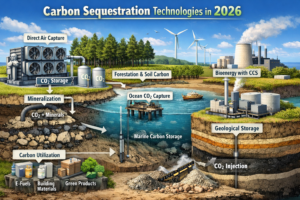
2. Engineered Carbon Removal
Technology driven solutions:
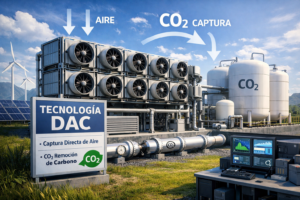
- Direct Air Capture (DAC): Filters CO₂ directly from ambient air.
- Biochar: Converts biomass into stable carbon applied to soil.
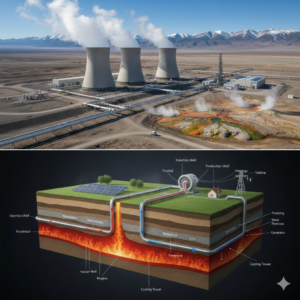
- BECCS: Bioenergy with carbon capture and storage.
- Enhanced rock weathering: Mineral reactions bind CO₂ into stable forms.
Advantages:
- High durability
- Measurable lifecycle accounting
- Scalable with capital investment
Limitations:
- High cost
- Limited current capacity
Leading Companies in Carbon Removal Credits
The carbon removal ecosystem includes specialized developers:
Direct Air Capture (DAC)
- Climeworks
- Carbon Engineering
Biochar
- Exomad Green
- Pacific Biochar
Enhanced Weathering & Mineralization
- Lithos Carbon
- Terradot
BECCS & Biomass Solutions
- Arbor
- Drax
These providers generate high-integrity carbon removal credits, often sold via long term offtake agreements.
Who Is Buying Carbon Removal Credits?
Major buyers include:
- Microsoft
- Google / Alphabet
- Meta
- Stripe (Frontier Climate Fund)
- Salesforce
These companies are shifting from traditional offsets toward durable removal carbon credits to meet carbon negative or science based targets.
Stripe’s Frontier initiative alone has committed $1 billion to permanent carbon removal by 2030.
Certification Standards for Carbon Removal Credits
Not all credits are equal. High quality puro carbon credits and other removal credits must be issued under credible standards.
Major Carbon Credit Registries
| Standard | Specialization | Focus Area |
|---|---|---|
| Puro.earth | Dedicated carbon removal standard | Issues CORCs (100+ year storage) |
| Verra (VCS) | Largest global registry | Expanding methodologies for CDR |
| American Carbon Registry (ACR) | U.S.-based technical registry | Protocols for DAC and BECCS |
| Gold Standard | Impact-driven certification | Expanding into engineered removals |
| ICVCM | Integrity oversight body | Core Carbon Principles (CCPs) |
Emerging Carbon Removal Standards
As the carbon dioxide removal (CDR) sector matures, new specialized standards are emerging:
| Organization | Country | Focus |
|---|---|---|
| Isometric | United Kingdom | Science-based methodologies for emerging CDR technologies (mineralization, biochar, ocean removal) |
| CSI (Carbon Standards International) | Switzerland | Certification frameworks for innovative removal methods |
| Carbonfuture | Germany | Digital MRV infrastructure for durable removals |
These emerging standards aim to address methodological gaps in baseline modeling, lifecycle analysis, and durability quantification.
Research & Scientific Oversight
Not all influential actors are certifiers. Some play a critical scientific validation role.
CarbonPlan is a U.S. based nonprofit research organization that evaluates the science behind carbon credits. While it does not issue carbon removal credits, it has been highly influential in advocating for:
- Stricter permanence requirements
- Transparent baseline methodologies
- Clear separation between removal and avoidance credits
- Public data transparency in voluntary carbon markets
As the voluntary carbon market evolves, buyers increasingly look beyond certification labels and assess scientific robustness and methodological transparency.
High integrity carbon removal credits today require both:
- Recognized certification.
- Independent scientific scrutiny.
Why Carbon Removal Credits Cost More
Carbon removal credits typically cost more because:
- Higher technology development costs
- Lower supply
- Strong corporate demand
- Strict durability requirements
Engineered durable credits can cost 5–20x more than avoidance credits. However, prices are expected to decline as innovation scales.
Market Outlook: Are Carbon Removal Credits the Future?
Several trends suggest yes:
- Growing distrust in low-quality avoidance credits
- Increased scrutiny on baseline methodologies
- Corporate net-zero commitments requiring durable removals
- Rapid innovation in DAC and mineralization
How to Integrate removal carbon credits into a Climate Strategy
A high-integrity strategy typically includes:
- Aggressive internal emissions reductions.
- Transitional use of high-quality avoidance credits.
- Increasing allocation toward durable carbon removal credits.
- Partnering with credible standards and verified registries.
Carbon removal credits are not a substitute for emissions reduction, they are a complement designed to address residual emissions and historical atmospheric carbon.
Conclusion
Carbon removal credits represent a structural evolution of the carbon market. As climate accountability intensifies and net-zero commitments become binding, removal carbon credits will move from niche instruments to core strategic assets.
Understanding the difference between reduction, avoidance, and removal is no longer optional. It is essential for climate credibility, regulatory compliance, and long-term resilience.
Frequently Asked Questions
- Are carbon removal credits permanent?
- Engineered removals can store CO₂ for centuries or millennia. Nature-based removals are typically less durable.
- Are carbon removal credits better than reduction credits?
- They serve different roles. Removals address historical emissions; reductions prevent new ones.
- Why are carbon removal credits more expensive?
- Due to higher development costs, durability requirements, and limited supply.
- What is the difference between carbon removal and carbon avoidance?
- Removal extracts existing CO₂; avoidance prevents emissions that would otherwise occur.