Direct Air Capture (DAC) is rapidly becoming the “star” technology of carbon removal because of its unique ability to eliminate historical CO2 directly from the atmosphere. Unlike traditional carbon capture systems that target emissions at smokestacks, direct air capture CO2 systems extract carbon already dispersed in ambient air (≈0.04% concentration).
As climate targets tighten across the U.S., Canada, the UK, Australia, and Europe, interest in capturing carbon from air has surged. But how does direct air capture actually work? Is it scalable? And which direct air capture companies are leading the charge?
What Is Direct Air Capture (DAC)?
Direct air capture is a chemical process that separates CO2 from ambient air to produce a concentrated stream of carbon dioxide. That CO2 can then be:
- Permanently stored underground (geological storage)
- Mineralized into rock
- Converted into fuels or industrial products
Because atmospheric CO2 is extremely diluted (~420 ppm), capturing carbon from air is far more energy intensive than capturing it from industrial exhaust streams. However, it offers one powerful advantage:
It can remove historical emissions — not just prevent new ones.
This makes direct air capture CO2 systems a critical complement to renewable energy and industrial decarbonization strategies.
Why Removing Historical CO2 Is Critical
Even if all emissions stopped today, excess atmospheric CO2 would continue warming the planet. Most net zero roadmaps assume large scale carbon removal by 2050. Without technologies like DAC, meeting 1.5°C or 2°C climate targets becomes extremely difficult.
Unlike reforestation or BECCS, direct air capture requires relatively little land per ton captured and can be located near renewable energy or geological storage sites.
How Direct Air Capture CO2 Technology Works
There are two dominant technological approaches to direct air capture:
Liquid Solvent Systems (NaOH / KOH)
This method uses an alkaline solution (sodium hydroxide or potassium hydroxide) that chemically reacts with CO2 to form carbonates.
Process steps:
- Air is pulled through a chemical absorber.
- CO2 reacts with the alkaline liquid.
- Carbonates are heated at very high temperatures (300–900°C).
- Pure CO2 is released and compressed.
- The solvent is regenerated and reused.
Energy profile:
Primarily high temperature thermal energy.
This approach is being deployed by 1PointFive, a subsidiary of Occidental Petroleum.
Their Stratos project in Texas aims to capture 500,000 tons of CO2 per year, using a “design once, build many” strategy to reduce capital expenditure and scale rapidly.
Solid Sorbent Systems (Amines, MOFs, Zeolites)
Here, air passes over porous solid materials coated with amines that bind CO2 molecules.
Process steps:
- Air flows over sorbent filters.
- CO2 attaches to the material surface.
- Heat (80–120°C) or vacuum releases concentrated CO2.
- Sorbents are reused for multiple cycles.
Energy profile:
Higher electrical demand (fans, vacuum pumps, heat pumps).
This is the model used by Climeworks, the global leader in operational DAC capacity.
In Iceland, Climeworks partners with Carbfix to mineralize CO2 underground, turning it into stone using geothermal energy. Their focus is permanence and purity ensuring the CO2 never reenters the atmosphere.
Skytree: Decentralized Circular DAC Strategy
Skytree represents a fundamentally different approach to direct air capture.
Instead of transporting captured CO2 for geological storage or enhanced oil recovery, Skytree installs modular DAC units such as the Cumulus model directly at the point of use.
Key characteristics:
- Installed on greenhouse rooftops or industrial facilities
- Captures CO2 from ambient air
- Injects purified CO2 directly into greenhouses or manufacturing processes
- Eliminates need for CO2 transported from fossil fuel refineries
- No pipeline infrastructure required
Circular Carbon Strategy
Skytree’s model is based on CO2 circularity. Rather than sourcing CO2 as a fossil byproduct delivered by truck, it captures atmospheric CO2 and reuses it locally as feedstock.
This approach is:
- More sustainable
- Less infrastructure-heavy than mega DAC hubs
- More energy efficient at small scale
- Ideal for distributed commercial applications
While Skytree does not target gigaton removal, it plays a critical role in decentralized carbon utilization markets.
Thermodynamic and Energy Limits
The theoretical minimum energy to capture 1 ton of CO2 from air is about 250 kWh. In practice, current systems require:
- 1,000–2,000 kWh per ton
- Significant heat input (liquid systems)
- Large industrial scale air movement
Energy sourcing is critical. If powered by fossil fuels, DAC could negate its own climate benefits. When powered by renewables or waste heat, it delivers net negative emissions.
Direct Air Capture vs Other Carbon Capture Technologies
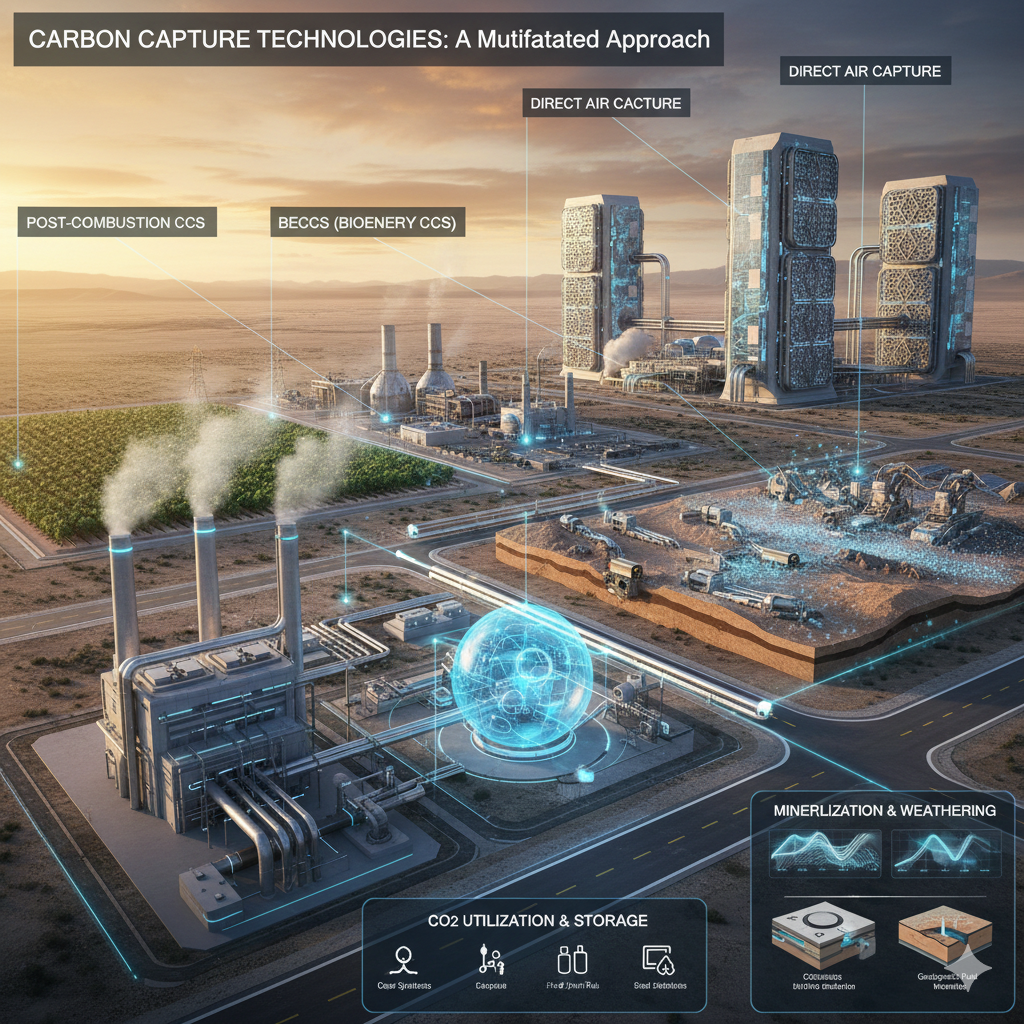
- Post-Combustion CCS
- Captures CO2 from smokestacks (3–15% concentration).
- Lower cost (~100 kWh/t) but limited to emission sources.
- BECCS
- Bioenergy with carbon capture.
- Can be net-negative but requires vast land and water.
- Mineralization & Enhanced Weathering
- Accelerates natural chemical reactions with minerals like calcium and magnesium.
Why DAC Is Different
Direct air capture CO2 systems operate independently of emission sources. Plants can be built wherever clean energy and storage are available, offering geographic flexibility unmatched by point-source CCS.
Direct Air Capture vs Other Carbon Removal Technologies
| Technology | CO2 Source | Energy Intensity | Land Use | Scalability | Key Advantage | Main Limitation |
|---|---|---|---|---|---|---|
| Direct Air Capture (DAC) | Ambient air (~0.04%) | High (1,000–2,000 kWh/t) | Low | High (modular) | Removes historical CO2 | Energy and cost intensive |
| Post-Combustion CCS | Industrial exhaust (3–15%) | Moderate (~100 kWh/t) | Low | Medium | Lower capture cost | Limited to emission sources |
| BECCS | Biomass combustion | Moderate–High | Very high | Limited | Net-negative potential | Land & water competition |
| Mineralization | Natural minerals | Low–Moderate | Medium | Long-term | Permanent storage | Slow reaction rates |
| Reforestation | Atmospheric CO2 | Low | Very high | Limited | Natural solution | Vulnerable to fires & land change |
Direct Air Capture Companies and Strategic Approaches
The rise of direct air capture companies signals a shift from pilot projects to industrial scaling.
PointFive (Oxy): Massive Scale Strategy
- Stratos plant: 500,000 t/year
- Focus: industrial replication
- Goal: drive costs below $200 per ton
- Strategy: standardized megaproject deployment
Climeworks: Permanence Strategy
- Orca & Mammoth plants in Iceland
- Uses geothermal energy
- CO2 mineralized into basalt rock
- Current cost: ~$600 per ton
Heirloom Carbon: Simplicity & Low Capex Model
Heirloom uses natural limestone to absorb CO2 through accelerated mineral cycling.
- Lower mechanical complexity
- Reduced capital cost
- Passive absorption potential
- Scalable modular design
Environmental Benefits of Capturing Carbon From Air
- Removes legacy CO2
- Reduces ocean acidification
- Offsets aviation and heavy industry
- Requires less land than reforestation
- Creates high-skilled industrial jobs
Estimates suggest DAC could remove up to 5 gigatons annually by 2050, if deployment accelerates.
Commercial Applications of Captured CO2
CO2 captured through direct air capture companies is used for:
- Permanent Geological Storage: Deep saline formations or basalt mineralization.
- Synthetic Fuels: Carbon neutral aviation fuel, gasoline, and methanol.
- Construction Materials: Carbon-infused concrete and cement.
- Industrial Uses: Greenhouses, beverages, specialty chemicals.
Global Market Outlook for Direct Air Capture
- The global DAC market is projected to grow at over 60% CAGR this decade. North America leads deployment, followed by Europe.
- Over 130 projects are announced worldwide, though only a fraction are fully financed.
- Reaching climate targets requires scaling from thousands of tons today to tens of millions annually by 2030 and gigatons by 2050.
- The next decade will determine whether direct air capture becomes a niche technology or a pillar of global climate strategy.
Is Direct Air Capture the Future of Carbon Removal?
Direct air capture is not a silver bullet, but it may be indispensable.
It complements:
- Emissions reductions
- Renewable energy expansion
- Industrial electrification
Capturing carbon from air is technically possible. The question is no longer “can it work?” but:
Can it scale fast enough — and cheaply enough — to matter?
If energy becomes cleaner and policies continue supporting negative emissions, direct air capture CO2 could become one of the defining climate technologies of the 21st century.
Frequently Asked Questions
1. What is direct air capture?
Direct air capture is a technology that removes CO2 directly from ambient air using chemical processes.
2. How much does direct air capture cost per ton?
Current costs range between $200 and $1,000 per ton, with future projections below $300/t.
3. Is capturing carbon from air energy intensive?
Yes. Most systems require between 1,000 and 2,000 kWh per ton of CO2.
4. Which direct air capture companies are leading the market?
1PointFive, Climeworks, and Heirloom Carbon are among the most prominent players.
5. Can direct air capture help achieve net zero?
Yes, particularly for offsetting hard-to-abate sectors like aviation and heavy industry.
6. Is DAC scalable to gigaton levels?
Technically possible, but requires massive renewable energy expansion and policy support.