
Environmental DNA (eDNA) is transforming how scientists, conservationists, and environmental managers monitor biodiversity. By detecting genetic material left behind by organisms in the environment, environmental DNA allows species detection without direct observation, capture, or disturbance.
Today, eDNA environmental DNA methods are considered one of the most powerful tools in modern ecology, conservation biology, and environmental monitoring. This guide explains what environmental DNA is, how eDNA sampling works, its applications, advantages, limitations, and future potential, using clear language without losing scientific rigor.
What Is Environmental DNA (eDNA)?
Environmental DNA (environmental DNA, eDNA) refers to genetic material released by living organisms into their surrounding environment. This DNA originates from:
- Skin and epithelial cells
- Mucus
- Feces
- Urine
- Blood
- Gametes
- Tissue fragments
Once released, eDNA can be found in water, soil, sediment, air, snow, ice, or on surfaces, making it possible to detect species without seeing or capturing them.
Key concept: eDNA makes it possible to detect organisms invisibly.
This non invasive nature is what makes environmental DNA so valuable for large scale biodiversity monitoring and conservation programs.
Why Has eDNA Revolutionized Environmental Monitoring?
Traditional biodiversity monitoring relied on:
- Physical trapping
- Visual surveys
- Netting or electrofishing
- Camera traps
These methods are often expensive, time consuming, invasive, and biased toward easily observable species.
Comparison With Traditional Monitoring Methods
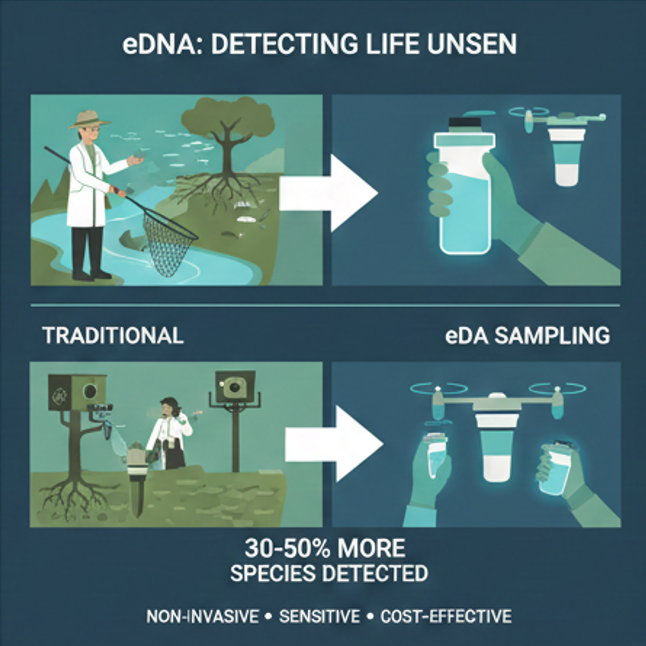
Environmental DNA sampling offers several advantages:
- Non invasive detection
- Higher sensitivity
- Lower cost at large scales
- Continuous and repeatable monitoring
Multiple studies have shown that eDNA detects 30–50% more species than traditional methods, especially in aquatic ecosystems.
Detecting Species Without Direct Observation
Because DNA persists in the environment for a limited time, eDNA provides near real-time evidence of species presence, making it ideal for early detection, conservation planning, and environmental impact assessment.
Applications of Environmental DNA (eDNA)
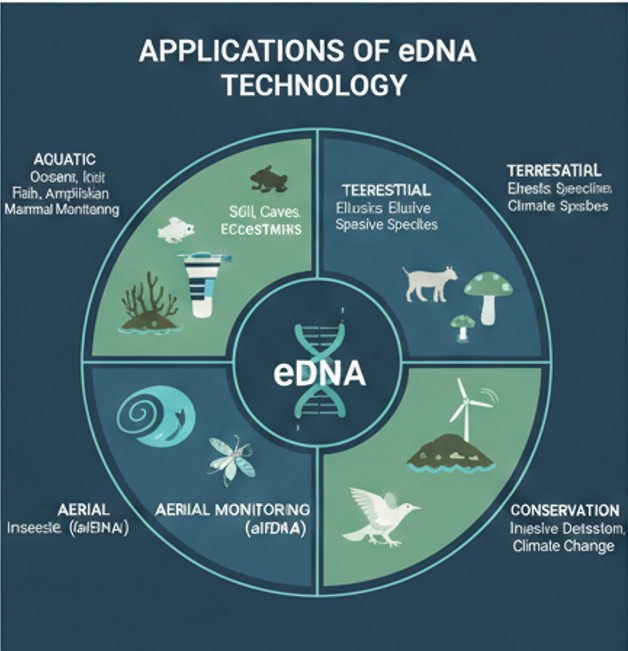
Biodiversity Monitoring in Aquatic Ecosystems
Aquatic systems are the most studied environments for environmental DNA:
- Rivers
- Lakes
- Oceans
- Coral reefs
- Wetlands
Common uses include:
- Fish community inventories
- Amphibian detection
- Monitoring aquatic mammals
- Deep sea biodiversity assessment
Environmental DNA has become a standard tool in freshwater and marine biodiversity monitoring.
Biodiversity Monitoring in Terrestrial Ecosystems
Environmental DNA is increasingly used on land through soil and substrate sampling:
- Forest soils
- Caves
- Savannas
- Tropical rainforests
Applications include detecting elusive mammals, reptiles, amphibians, and studying soil microbial communities.
Aerial Biodiversity Monitoring (airDNA)
One of the newest frontiers is airborne environmental DNA (airDNA). Researchers have demonstrated that DNA can be captured directly from air samples.
Experimental applications include:
- Insect monitoring
- Bird detection
- Early warning of invasive species
AirDNA research is advancing rapidly in countries such as Sweden, the United Kingdom, and Canada.
Conservation of Endangered Species
Environmental DNA plays a critical role in conservation by allowing scientists to:
- Confirm presence of rare species
- Detect remnant populations
- Evaluate protected areas
Notable examples include:
- Axolotl conservation in Mexico
- Giant panda monitoring in China
- Iberian lynx conservation in Spain
- Monitoring protected shark species
Detection of Invasive Species
Early detection is essential for managing biological invasions. eDNA sampling enables:
- Rapid detection
- Prevention of ecosystem damage
Examples include:
- Asian carp in the United States
- Zebra mussels in Europe
- Invasive frogs in Australia
In many cases, environmental DNA detects invasions before they are visually observable.
Environmental Impact Assessment and Climate Change
Environmental DNA is increasingly used in:
- Dam construction projects
- Mining operations
- Ports and coastal infrastructure
- Wind farms
It supports baseline studies, monitoring during construction, and post impact evaluation.
In climate change research, eDNA helps track:
- Shifts in species distribution
- Migration patterns
- Biodiversity loss
- Changes in polar and marine ecosystems
eDNA Sampling and Analysis Methods
Environmental Sample Collection
| Medium | Sampling Method |
|---|---|
| Water | Filtration (0.2–0.45 μm) |
| Soil | Direct extraction |
| Sediment | Core sampling |
| Air | Specialized filters |
| Snow/Ice | Controlled melting |
Environmental DNA Extraction
DNA extraction can be performed using:
- Commercial kits
- Chemical extraction protocols
- Substrate specific optimized methods
Genetic Amplification and Sequencing
Key molecular techniques include:
- PCR
- qPCR
- Metabarcoding
- Next generation sequencing (NGS)
Common genetic markers:
- COI
- 12S
- 16S
- ITS
Bioinformatic Analysis of eDNA
Bioinformatics is essential for eDNA environmental DNA analysis:
- Comparison with genetic reference databases
- Taxonomic identification algorithms
- Community composition analysis
Advantages of Using Environmental DNA
- Non invasive
- High sensitivity
- Detects rare and cryptic species
- Reduced field effort
- Suitable for remote locations
- Highly scalable
Limitations and Challenges of Environmental DNA
Despite its strengths, eDNA has limitations:
- Does not provide exact abundance estimates
- DNA degradation over time
- DNA transport by water currents
- Dependence on reference databases
- Risk of contamination
- Complex ecological interpretation
Acknowledging these challenges is essential for responsible use.
Recent Scientific Advances in Environmental DNA
- Quantitative eDNA and eRNA
- Quantitative eDNA improves biomass estimation
- eRNA indicates recent biological activity
- Portable Sequencing and Real Time Monitoring
- Portable sequencers (e.g., Oxford Nanopore)
- Autonomous sampling systems
- Robotic field platforms
- Artificial Intelligence in eDNA Analysis
- Automated taxonomic classification
- Large scale biodiversity modeling
- Predictive conservation analytics
International Case Studies of eDNA Applications
- Japan: National river fish monitoring programs
- Europe: Integration into the Water Framework Directive
- Latin America: Amazon biodiversity surveys and axolotl conservation
- China: Forest biodiversity and panda monitoring
- Africa: Non invasive monitoring of large mammals in national parks
International Regulations and Initiatives
Key global initiatives include:
- International Barcode of Life (iBOL)
- Global Biodiversity Information Facility (GBIF)
- Convention on Biological Diversity (CBD)
- European Horizon projects
- FAO environmental monitoring programs
Environmental DNA is increasingly integrated into environmental legislation worldwide.
The Future of Environmental DNA
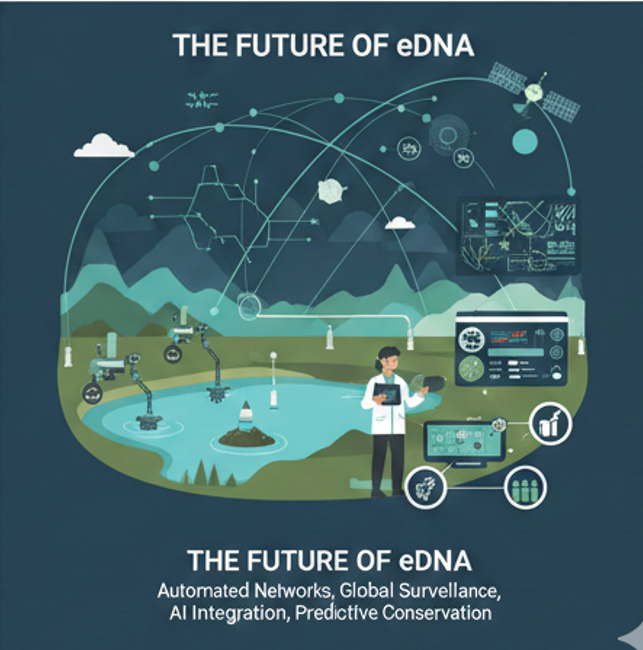
Emerging trends include:
- Automated biodiversity monitoring networks
- Global eDNA surveillance systems
- Integration with satellite data
- Citizen science initiatives
- Predictive conservation modeling
Environmental DNA is widely regarded as a core technology of 21st century ecology.
eDNA as a Key Tool for Biodiversity Conservation
Environmental DNA has fundamentally changed how biodiversity is monitored and protected. By enabling non-invasive, scalable, and highly sensitive species detection, eDNA environmental DNA methods are reshaping conservation, environmental management, and climate science.
As technology advances, environmental DNA will play an even greater role in protecting ecosystems and informing global environmental policy.
Frequently Asked Questions About Environmental DNA (eDNA)
What is environmental DNA (eDNA)?
Environmental DNA is genetic material released by organisms into the environment, allowing species detection without direct observation.
How long does eDNA persist in the environment?
Persistence varies from hours to weeks, depending on environmental conditions.
Can eDNA estimate species abundance?
eDNA provides presence data; abundance estimates remain approximate.
What ecosystems can be studied using eDNA?
Aquatic, terrestrial, aerial, polar, and marine ecosystems.
Is environmental DNA reliable for conservation decisions?
Yes, when used alongside ecological expertise and proper protocols.