What Are Environmental Technologies and Why Are They Essential for Global Sustainability?
Environmental technologies often referred to as environmental tech, green technology, or clean technology include all technological solutions designed to prevent, reduce, or remediate environmental damage while supporting sustainable economic growth. Today, environmental technology is no longer a niche sector; it has become a global ecosystem of sustainability tech companies, digital platforms, and emerging environmental technologies shaping the future of energy, industry, cities, and natural systems.
From renewable energy systems and water treatment technologies to air pollution control and environmental monitoring, global environmental technology plays a critical role in addressing climate change, resource scarcity, and environmental degradation. As regulations tighten and sustainability becomes a core business driver, innovative environmental technology is increasingly seen as both a necessity and a market opportunity.
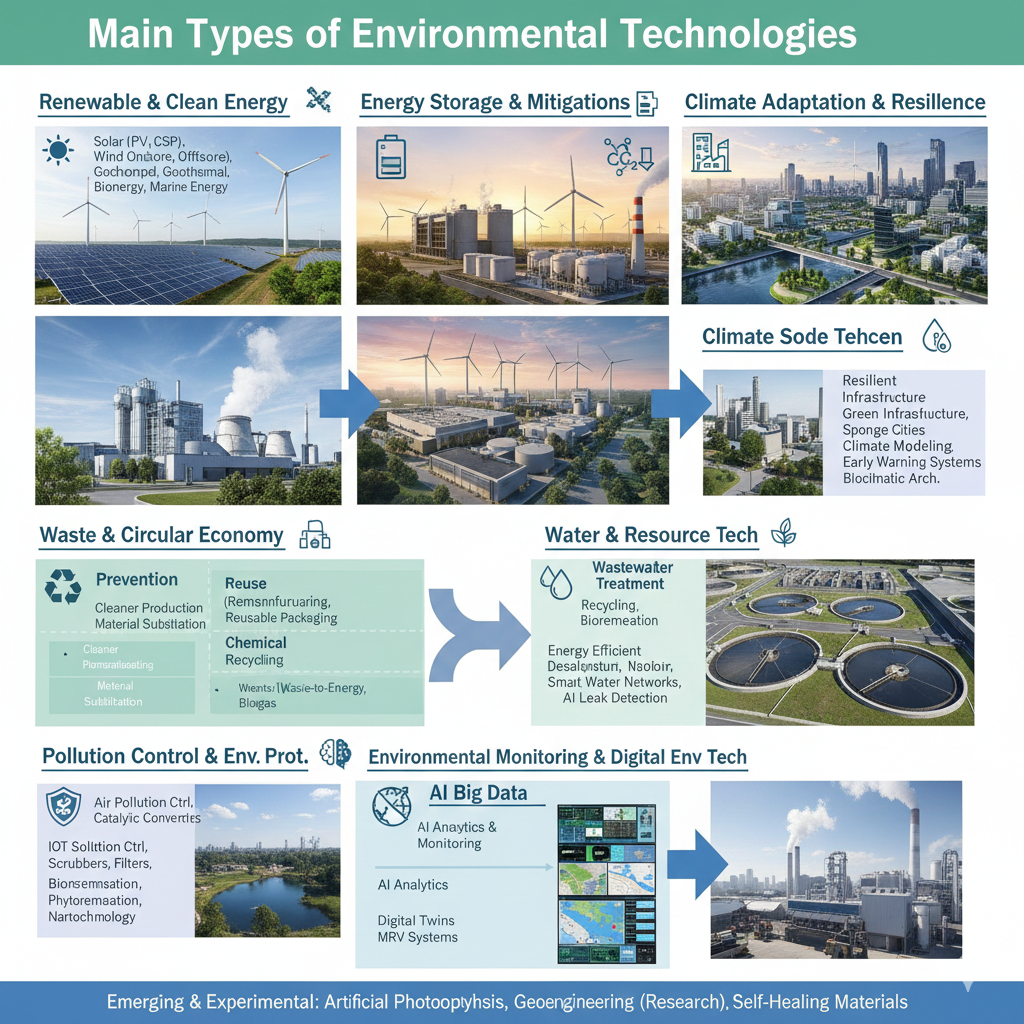
Main Types of Environmental Technologies
Renewable and Clean Energy Technologies
Renewable energy technologies form the backbone of modern environmental technology. These solutions aim to replace fossil fuels with cleaner, low carbon alternatives:
- Solar energy (photovoltaic, bifacial, perovskite, CSP, (onshore, offshore, floating wind)
- Hydropower (micro, small-scale, pumped storage)
- Geothermal energy (conventional and enhanced systems)
- Bioenergy (biogas, biomethane, sustainable biomass)
- Marine energy (tidal, wave, osmotic – emerging)
These environmental technologies reduce greenhouse gas emissions while improving energy security and resilience. Many sustainability tech companies are now integrating renewable systems with digital optimization and storage solutions.
Energy Storage Technologies and Energy Carriers
Energy storage is essential for stabilizing renewable energy systems and enabling the energy transition. Key environmental technologies include:
- Lithium ion batteries (LFP, NMC)
- Sodium-ion batteries
- Solid-state batteries (emerging)
- Flow batteries
- Green hydrogen and low-carbon hydrogen
- Green ammonia
- Power-to-X technologies
- Thermal energy storage
- Compressed air energy storage (CAES)
These technologies support grid flexibility and enable deep decarbonization across industry, transport, and power generation.
Climate Change Mitigation Technologies
Mitigation focused environmental technologies aim to reduce or remove greenhouse gas emissions:
- Carbon capture and storage (CCS)
- Carbon capture, utilization, and storage (CCUS)
- Direct air capture (DAC)
- Biochar and soil carbon sequestration
- CO₂ mineralization
- Carbon negative construction materials
- Nature based solution
- Carbon smart agriculture
Innovative environmental technology in this area is rapidly expanding, driven by climate policies and carbon markets.
Climate Adaptation and Resilience Technologies
As climate impacts intensify, adaptation technologies are becoming increasingly important:
- Climate resilient infrastructure
- Green infrastructure and nature-based design
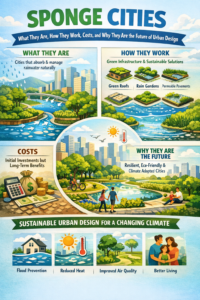
- Sponge cities and urban flood management
- Climate modeling and risk analytics
- Early warning systems
- Passive urban cooling
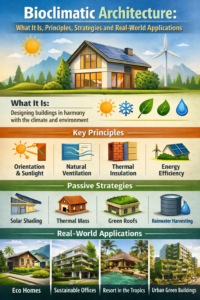
- Bioclimatic architecture
These emerging environmental technologies reduce vulnerability while protecting communities and ecosystems.
Environmental Technologies for Waste Management and the Circular Economy
Prevention, Eco-Design, and Cleaner Production
The most effective environmental technologies focus on preventing waste at the source:
- Cleaner production systems
- Eco design and material substitution
- Industrial symbiosis
- Process digitalization
- Sustainable product lifecycle design
These approaches reduce environmental impact while improving efficiency and competitiveness.
Reuse, Reutilization, and Remanufacturing
Circular economy technologies extend product life and reduce resource extraction:
- Remanufacturing and refurbishment
- Reusable packaging systems
- Industrial reuse platforms
- Treated water reuse technologies
Such solutions are increasingly adopted by sustainability tech companies seeking cost savings and regulatory compliance.
Advanced Recycling and Waste to Energy Technologies
Innovative environmental technology is transforming waste into valuable resources:
- Chemical recycling (pyrolysis, gasification, solvolysis)
- Enzymatic and molecular recycling
- Upcycling technologies
- Waste-to-energy systems
- Biogas and biomethane production
- Refuse-derived fuels (RDF)
These technologies support both waste reduction and energy recovery.
Water and Water Resource Technologies
Wastewater Treatment and Water Reuse Technologies
Innovative environmental technology is transforming waste into valuable resources:
- Chemical recycling (pyrolysis, gasification, solvolysis)
- Enzymatic and molecular recycling
- Upcycling technologies
- Waste to energy systems
- Biogas and biomethane production
- Refuse-derived fuels (RDF)
These technologies support both waste reduction and energy recovery.
Desalination, Water Harvesting, and Smart Water Management
Emerging environmental technologies in water management include:
- Energy efficient desalination
- Atmospheric water generation
- Smart water networks (IoT-enabled)
- AI-based leak detection and optimization
These innovations are critical for arid and water-stressed regions worldwide.
Pollution Control and Environmental Protection Technologies
Air Pollution Control Technologies
Innovative environmental technology is transforming waste into valuable resources:
- Chemical recycling (pyrolysis, gasification, solvolysis)
- Enzymatic and molecular recycling
- Upcycling technologies
- Waste-to-energy systems
- Biogas and biomethane production
- Refuse-derived fuels (RDF)
These technologies support both waste reduction and energy recovery.
Water and Soil Remediation Technologies
Pollution remediation technologies address contaminated environments:
- Bioremediation
- Phytoremediation
- Physical-chemical remediation
- Environmental nanotechnology
These solutions are critical for restoring degraded ecosystems and industrial sites.
Environmental Monitoring and Digital Environmental Technologies
Environmental Sensors, IoT, and Monitoring Systems
Digital environmental technology enables real-time measurement and control:
- Environmental sensors and monitoring stations
- Drone based monitoring
- Satellite observation and remote sensing
- GIS and spatial analysis platforms
Artificial Intelligence, Big Data, and Environmental Digital Twins
Advanced EnvTech solutions include:
- AI powered environmental analytics
- Big data platforms for sustainability
- Environmental digital twins
- MRV (Measurement, Reporting, Verification) systems
- Blockchain for environmental traceability
These innovative environmental technologies improve transparency, efficiency, and decision making.
Emerging and Experimental Environmental Technologies
Disruptive Innovations in Carbon Capture and Geoengineering
Some emerging environmental technologies are still experimental but promising:
- Artificial photosynthesis
- Atmospheric methane capture
- Enhanced weathering
- Climate geoengineering (research stage)
These solutions remain under evaluation due to technical and ethical considerations.
New Frontiers in Materials, Energy, and Environmental Biotechnology
- Self-healing and low-impact materials
- Radiative cooling materials
- Environmental biotechnology
- Synthetic biology for sustainability
Such innovations represent the cutting edge of global environmental technology.
Global Trends and the Future of Environmental Technologies
Environmental technologies are evolving toward integration, digitalization, and scalability. Key global trends include:
- Convergence of digital and physical environmental systems
- Growth of sustainability tech companies
- Stronger climate and environmental regulations
- Increased investment in emerging environmental technologies
- Expansion of global environmental technology markets
As sustainability becomes a core economic driver, environmental technology will continue to shape industries, cities, and societies worldwide.
Frequently Asked Questions About Environmental Technologies
What is environmental technology?
Environmental technology refers to technological solutions designed to protect the environment, reduce pollution, and promote sustainable resource use.
What are emerging environmental technologies?
They include advanced carbon capture, digital environmental platforms, next-generation energy storage, and experimental climate solutions.
How do environmental technologies support sustainability?
They reduce emissions, improve efficiency, protect ecosystems, and enable long-term economic resilience.
What is the role of digital environmental technology?
Digital tools such as AI, sensors, and data platforms enhance monitoring, optimization, and environmental decision-making.