What Is Multi Criteria Analysis?
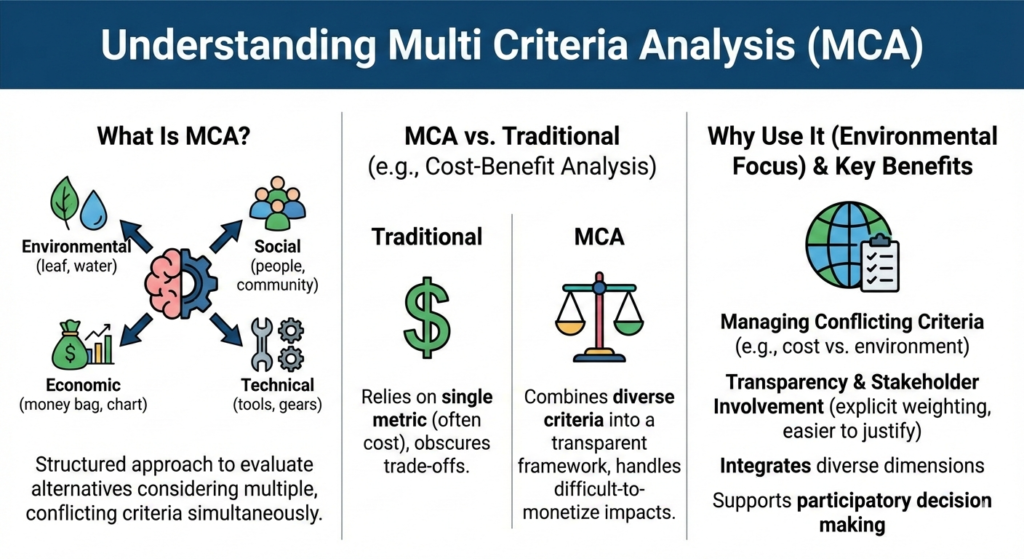
Multi Criteria Analysis (MCA) also known as Multiple Criteria Decision Analysis (MCDA) or Multi Criteria Decision Making (MCDM)is a structured decision support approach used to evaluate and rank alternatives when multiple, often conflicting criteria must be considered simultaneously.
Unlike traditional decision making tools that rely on a single metric (such as cost), multi criteria analysis allows decision makers to combine environmental, social, economic, and technical criteria into a single, transparent evaluation framework.
MCDA is especially valuable in complex contexts such as environmental impact assessment (EIA), sustainability planning, public policy, and infrastructure development, where impacts cannot be reduced to a single monetary value.
MCDA vs Traditional Decision Making Approaches
Many decisions are still based on cost-benefit analysis (CBA) or intuitive judgment. While useful, these approaches often fall short when:
- Environmental impacts are difficult to monetize
- Social acceptance matters as much as technical feasibility
- Long term sustainability outweighs short term cost savings
Multi criteria analysis addresses these limitations by explicitly structuring trade offs between competing objectives, making the reasoning behind decisions easier to understand, justify, and communicate.
👉 Internal linking opportunity: Cost-benefit analysis vs MCDA, sustainability assessment methods.
Why Use Multi Criteria Analysis in Environmental Evaluation?

Limitations of Cost-Benefit Analysis in Environmental Decisions
Environmental decisions often involve non market values, such as biodiversity loss, ecosystem services, or community well being. Assigning a single monetary value to these impacts can oversimplify reality and obscure critical trade offs.
Multi criteria decision analysis allows these dimensions to be evaluated alongside economic costs, rather than being forced into them.
Managing Conflicting Environmental, Social, and Economic Criteria
In environmental projects, conflicts are the norm:
- Lower cost vs higher environmental impact
- Technical efficiency vs social acceptance
- Short term gains vs long term sustainability
MCDA provides a formal way to compare alternatives holistically, ensuring that no critical criterion is ignored.
Transparency and Stakeholder Involvement
One of the strongest advantages of multi criteria analysis is transparency. Criteria selection, weighting, and evaluation are explicit, making the process:
- Easier to audit
- Easier to explain to regulators
- Easier to discuss with stakeholders and experts
This is particularly important in environmental impact assessment, where decisions are often scrutinized by multiple parties.
How Does a Multi Criteria Analysis Work?
Although methods vary, most MCDA processes follow a similar structure.
- Problem Definition and Decision Context:
- The first step is clearly defining the decision problem, objectives, and constraints. For example:
- Selecting a location for a renewable energy facility
- Choosing a waste treatment technology
- Identification of Alternatives: Alternatives represent the different options available, such as project designs, locations, or technologies.
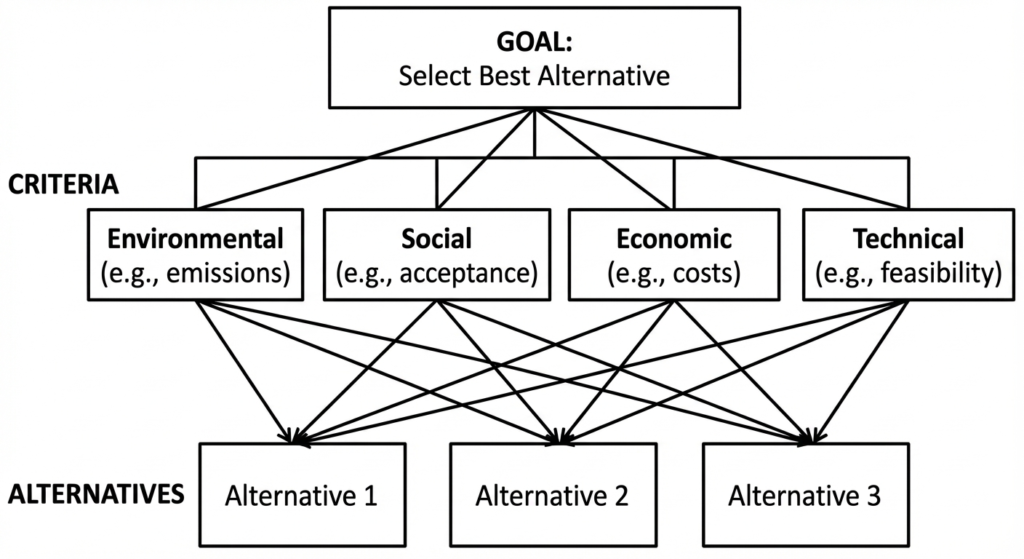
- Selection of Criteria: Criteria typically fall into several categories:
- Environmental: emissions, water use, land disturbance
- Social: public acceptance, health impacts
- Economic: investment and operational costs
- Technical: feasibility, reliability
- Weighting Criteria and Expert Judgment: Not all criteria are equally important. MCDA explicitly assigns weights based on expert judgment, stakeholder priorities, or policy goals. This step is critical and also one of the most debated ecause weighting influences final rankings.
- Evaluation, Aggregation, and Ranking of Alternatives: Each alternative is evaluated against all criteria, and results are aggregated using a mathematical method to produce a ranking or preference structure.
- Interpreting Results for Decision Making: MCDA does not “make the decision” automatically. Instead, it provides a structured, evidence based foundation to support informed judgment.
Main Multi Criteria Analysis Methods
AHP – Analytic Hierarchy Process
AHP structures the problem into a hierarchy (goal → criteria → alternatives) and uses pairwise comparisons to derive weights.
Best used when:
- Criteria are mostly qualitative
- Expert judgment plays a major role
Widely applied in environmental impact assessment and project prioritization.
TOPSIS – Technique for Order Preference by Similarity to Ideal Solution
TOPSIS ranks alternatives based on their distance from an ideal and a worst case solution.
Best used when:
- Quantitative data are available
- A clear ranking is needed
Common in technology and infrastructure comparisons.
ELECTRE Methods
ELECTRE methods rely on outranking relationships, allowing partial preferences rather than strict rankings.
Best used when:
- Trade offs are complex
- Consensus is difficult
Often applied in strategic environmental decisions.
PROMETHEE
PROMETHEE calculates preference flows and offers strong visualization tools (e.g., GAIA plane).
Best used when:
- Communication and visualization matter
- Both qualitative and quantitative criteria are present
Other MCDA Methods
- MAUT / MAVT (utility and value theory)
- ANP (network based extension of AHP)
- VIKOR
- Fuzzy AHP and Fuzzy TOPSIS (handling uncertainty)
Choosing the Right MCDA Method for Environmental Impact Assessment
No single method is universally “best.” The choice depends on:
- Data availability
- Nature of criteria (qualitative vs quantitative)
- Level of uncertainty
- Decision context and stakeholders
In practice, simplicity, transparency, and stakeholder acceptance are often as important as mathematical sophistication.
Advantages and Limitations of Multi Criteria Analysis
Key Advantages
- Integrates environmental, social, and economic dimensions
- Handles conflicting objectives explicitly
- Improves transparency and justification
- Supports participatory decision making
Key Limitations
- Subjectivity in weighting criteria
- Data requirements can be demanding
- Results require careful interpretation
Understanding these limitations is essential to avoid misuse.
Frequently Asked Questions About Multi Criteria Analysis
What is multi criteria analysis used for?
To support decisions involving multiple, conflicting criteria.
Is MCDA subjective?
Partially but subjectivity is made explicit and transparent.
Which MCDA method is best for environmental assessment?
It depends on the decision context, data, and stakeholders.
Can MCDA combine qualitative and quantitative data?
Yes, this is one of its main strengths.
Conclusion
Multi Criteria Analysis (MCDA) is one of the most powerful tools available for environmental decision making. By integrating diverse criteria into a structured framework, it enables clearer, more transparent, and more defensible choices especially in contexts where sustainability truly matters.