What are Nature Based Solutions? (Nature Based Solutions Definition)
Nature based solutions (NbS) are actions that protect, sustainably manage, and restore natural or modified ecosystems in ways that address major societal challenges effectively and adaptively, while simultaneously delivering benefits for human wellbeing and biodiversity. This definition, formally established by the International Union for Conservation of Nature (IUCN), has become the global reference framework for governments, multilateral banks, climate funds, and private investors.
Unlike traditional “grey infrastructure” approaches that rely heavily on engineered systems, nature based solutions work with natural processes, enhancing ecosystem services such as carbon sequestration, water regulation, climate resilience, disaster risk reduction, and biodiversity conservation. Because they generate multiple co benefits, NbS are increasingly recognized as cost effective, scalable, and resilient solutions for climate change, water security, food systems, and urban development.
From restoring forests and wetlands to deploying green roofs and agroforestry systems, nature based solutions bridge environmental protection and economic development, making them central to sustainable growth strategies worldwide.
Classification and Global Standard
The Five Types of Nature Based Solutions
The IUCN classifies nature based solutions into five core approaches, which together cover the full spectrum of NbS interventions:
- Ecosystem Restoration
Includes forest landscape restoration, wetland rehabilitation, coral reef recovery, and ecological engineering aimed at recovering degraded ecosystems. - Ecosystem Based Adaptation and Mitigation
Uses ecosystems to help societies adapt to climate change and reduce greenhouse gas emissions, such as mangroves for coastal protection or forests as carbon sinks. - Green and Blue Infrastructure
Urban parks, green roofs, rain gardens, permeable pavements, and restored waterways that enhance resilience in cities. - Integrated Ecosystem Management
Landscape scale approaches such as integrated watershed management, coastal zone management, and sustainable land use planning. - Ecosystem Protection and Conservation
Protected areas, marine reserves, ecological corridors, and conservation policies that safeguard critical habitats.
IUCN Global Standard for NbS
To prevent misuse and greenwashing, the IUCN established a Global Standard for Nature Based Solutions, built around eight criteria covering environmental integrity, biodiversity conservation, social equity, economic viability, and long term sustainability. This standard is now widely used to design, assess, and finance NbS projects, particularly in climate and development finance.
Mitigation and Adaptation
Carbon Sequestration and Climate Mitigation
Nature based climate solutions play a critical role in mitigating climate change. Ecosystems such as forests, peatlands, grasslands, mangroves, and seagrasses act as powerful carbon sinks. Scientific assessments estimate that up to 30% of the global mitigation needed by 2050 could come from well designed NbS.
Forests alone avoid nearly 10% of global annual emissions by storing carbon in biomass and soils. Coastal ecosystems contribute “blue carbon,” storing carbon at rates significantly higher than terrestrial forests while also protecting shorelines from erosion and storms.
Climate Adaptation and Risk Reduction
Beyond mitigation, NbS significantly reduce climate vulnerability. Healthy forests regulate water cycles, lowering flood and drought risks. Wetlands absorb excess rainfall, while urban vegetation reduces heat stress and improves air quality. In coastal regions, mangroves and dunes dissipate wave energy, protecting infrastructure and communities during extreme weather events.
Limits and Risks
Poorly designed NbS can backfire. Monoculture plantations, inappropriate afforestation, or projects that ignore local communities may harm biodiversity, strain water resources, or undermine livelihoods. Science based planning, participatory governance, and ecosystem specific design are essential to ensure long term benefits.
Nature Based Solutions for Water Management
Watersheds, Wetlands, and Flood Control
Water related challenges are among the most mature applications of NbS. Restoring watersheds, riparian buffers, and floodplains improves water retention, filtration, and groundwater recharge, reducing dependence on costly treatment infrastructure.
Wetlands function as natural “sponges,” lowering flood peaks and removing 60 90% of sediments and nutrients before water reaches downstream communities.
Sponge Cities and Urban Water Solutions
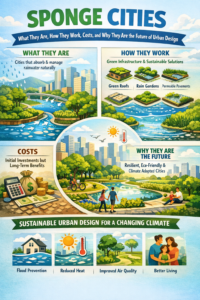
The “sponge city” model demonstrates how nature based solutions can transform urban water management. By integrating green spaces, permeable surfaces, and urban wetlands, cities can infiltrate most rainfall locally, reducing floods while improving microclimates and livability.
Implementation Challenges
NbS for water require land availability, coordinated governance, and long term monitoring. Benefits often grow over time, making early investment and policy alignment critical.
Nature Based Solutions and Biodiversity Conservation
Biodiversity conservation is both a core objective and a key co benefit of NbS. Protected areas, ecological corridors, and restored habitats safeguard species while maintaining ecosystem services such as pollination, erosion control, and climate regulation.
Large scale conservation networks marine reserves, forest corridors, and landscape mosaics demonstrate how NbS can operate at scale. However, effectiveness depends on native species selection, connectivity, and enforcement. Not all “green” interventions qualify as NbS unless they deliver measurable biodiversity gains.
Nature Based Solutions for Urban Resilience
Green and Blue Infrastructure in Cities
Urban NbS parks, green roofs, restored rivers, wetlands, and tree lined streets are essential for heat mitigation, flood control, and public health. Vegetation reduces urban temperatures, captures pollutants, and enhances mental well being.
Equity and Governance
Urban nature based solutions must be inclusive. Without equitable planning, green investments can concentrate benefits in wealthier neighborhoods. Successful NbS integrate social considerations, accessibility, and community participation.
Nature Based Solutions in Agriculture and Land Use
Agroforestry and Regenerative Agriculture
Agriculture offers major opportunities for NbS through agroforestry, conservation tillage, crop rotation, and soil regeneration. These practices enhance soil carbon, improve water retention, and reduce reliance on chemical inputs.
Soil Carbon and Biochar
Soils store more carbon than the atmosphere and vegetation combined. Practices such as biochar application and organic matter management can lock carbon into soils for decades while improving fertility and yields.
Scaling Barriers
Adoption remains limited due to upfront costs, knowledge gaps, and short term yield risks. Policy incentives, carbon markets, and payments for ecosystem services are key to scaling these solutions.
Nature Based Carbon Projects and Climate Finance
Role in Carbon Markets
Nature based carbon projects including REDD+, mangrove restoration, and soil carbon initiatives are increasingly integrated into voluntary carbon markets. When properly designed, they deliver verified emissions reductions alongside biodiversity and social co benefits.
Financing Nature Based Solutions
Despite their potential, NbS face a massive financing gap, estimated at hundreds of billions of dollars annually. Public funding, climate funds, green bonds, blended finance, and private capital are all needed to unlock scale.
Payments for ecosystem services, results based finance, and biodiversity credits are emerging mechanisms that align financial returns with environmental outcomes.
Global Examples of Nature Based Solutions by Sector
| Solution Type | Sector | Key Benefits | Regions |
|---|---|---|---|
| Forest protection & restoration | Climate, biodiversity | CO₂ capture, water regulation, jobs | Amazon, Congo, Europe |
| Mangrove restoration | Coastal risk, climate | Storm protection, blue carbon, fisheries | Mekong, Caribbean |
| Wetland restoration | Water management | Flood control, filtration | Everglades, Delta del Ebro |
| Urban green infrastructure | Cities | Cooling, flood reduction, health | Singapore, Colombo |
| Agroforestry | Agriculture | Productivity, soil carbon | Latin America, Africa |
| Landscape restoration | Land degradation | Food security, carbon sinks | Bonn Challenge countries |
Limitations, Risks, and Best Practices
Nature based solutions are not a silver bullet. They must complement not replace emissions reductions and engineered systems where necessary. Best practices include:
- Ecosystem specific design
- Community participation
- Long term monitoring
- Alignment with climate, biodiversity, and development goals
Frequently Asked Questions (FAQ)
What qualifies as a nature based solution?
An intervention that works with ecosystems to address societal challenges while delivering biodiversity and human well being benefits.
Are nature based solutions enough to tackle climate change?
No. They are a critical complement to rapid emissions reductions and clean energy transitions.
How are nature based solutions financed?
Through public budgets, climate funds, carbon markets, green bonds, and private investment.
What is the difference between NbS and green infrastructure?
Green infrastructure is one subset of NbS, mainly focused on urban environments.
Fuentes
- Intergovernmental Panel on Climate Change (IPCC). (2022). Climate change 2022: Mitigation of climate change. Contribution of Working Group III to the Sixth Assessment Report. Cambridge University Press.
- Intergovernmental Panel on Climate Change (IPCC). (2022). Climate change 2022: Impacts, adaptation and vulnerability. Cambridge University Press.
- World Wide Fund for Nature (WWF). (2020). Nature-based solutions and climate change. WWF International.
- Food and Agriculture Organization of the United Nations (FAO). (2022). Nature-based solutions in agriculture. FAO.
- United Nations Environment Programme & Food and Agriculture Organization of the United Nations. (2020). The UN decade on ecosystem restoration 2021–2030. UNEP & FAO.
- Bonn Challenge. (2023). Progress report. Global Partnership on Forest and Landscape Restoration.
- Chazdon, R. L., & Guariguata, M. R. (2016). Natural regeneration as a tool for large-scale forest restoration in the tropics. Biotropica, 48(6), 716–730.
- Ramsar Convention Secretariat. (2018). Nature-based solutions for water. Ramsar Convention Secretariat.
- Ramsar Convention Secretariat. (2021). Wetlands and disaster risk reduction. Ramsar Convention Secretariat.
- World Bank. (2019). Integrating green and gray infrastructure: The role of nature-based solutions. World Bank.
- Kabisch, N., Korn, H., Stadler, J., & Bonn, A. (2017). Nature-based solutions to climate change adaptation in urban areas. Springer.
- European Commission. (2015). Towards an EU research and innovation policy agenda for nature-based solutions. European Union.
- United Nations Office for Disaster Risk Reduction (UNDRR). (2021). Words into action: Nature-based solutions for disaster risk reduction. UNDRR.
- Narayan, S., et al. (2017). The effectiveness, costs and coastal protection benefits of natural and nature-based defenses. PLOS ONE, 12(5), e0174735.
- Food and Agriculture Organization of the United Nations (FAO). (2020). The state of the world’s forests 2020: Forests, biodiversity and people. FAO.
- Lal, R. (2020). Regenerative agriculture for food and climate. Journal of Soil and Water Conservation, 75(5), 123A–124A.