Geothermal energy is one of the most powerful yet underutilized renewable energy sources on Earth. Unlike solar panels or wind turbines that depend on weather conditions, geothermal systems generate continuous, reliable power 24/7 using heat stored beneath the Earth’s surface.
In this complete guide, you’ll learn:
- What geothermal energy is and how it works
- The different types of geothermal power plants
- How geothermal heating and cooling systems function
- Real geothermal cost considerations
- Environmental advantages and limitations
- A full comparison between geothermal vs solar, wind, hydro, and biomass
- Global leaders and cutting-edge innovations
What Is Geothermal Energy?
Definition and Geological Context
Geothermal energy is the heat stored within the Earth’s crust. This heat originates from:
- The planet’s formation
- Radioactive decay of minerals
- Magmatic activity beneath tectonic plates
At depths of just 1–3 kilometers, temperatures can exceed 200°C in volcanically active regions. These geothermal reservoirs contain hot water or steam trapped in porous rock formations beneath impermeable layers.
High enthalpy geothermal resources are commonly found along tectonic plate boundaries such as:
- The Pacific Ring of Fire
- The East African Rift
- Volcanic hotspots like Yellowstone and Hawaii
Geothermal resources are classified by temperature:
| Type | Temperature | Main Use |
|---|---|---|
| High | ≥200°C | Electricity generation |
| Medium | 150–200°C | Power + industrial heat |
| Low | 90–150°C | Direct heating applications |
Types of Geothermal Resources
- Hydrothermal systems – Naturally occurring hot water or steam reservoirs.
- Enhanced Geothermal Systems (EGS) – Hot dry rock where water is injected to create permeability.
- Geopressured systems – Deep, pressurized brine reservoirs containing heat and dissolved gases.
Hydrothermal systems are currently the most widely exploited for commercial geothermal power.
How Does Geothermal Energy Work?
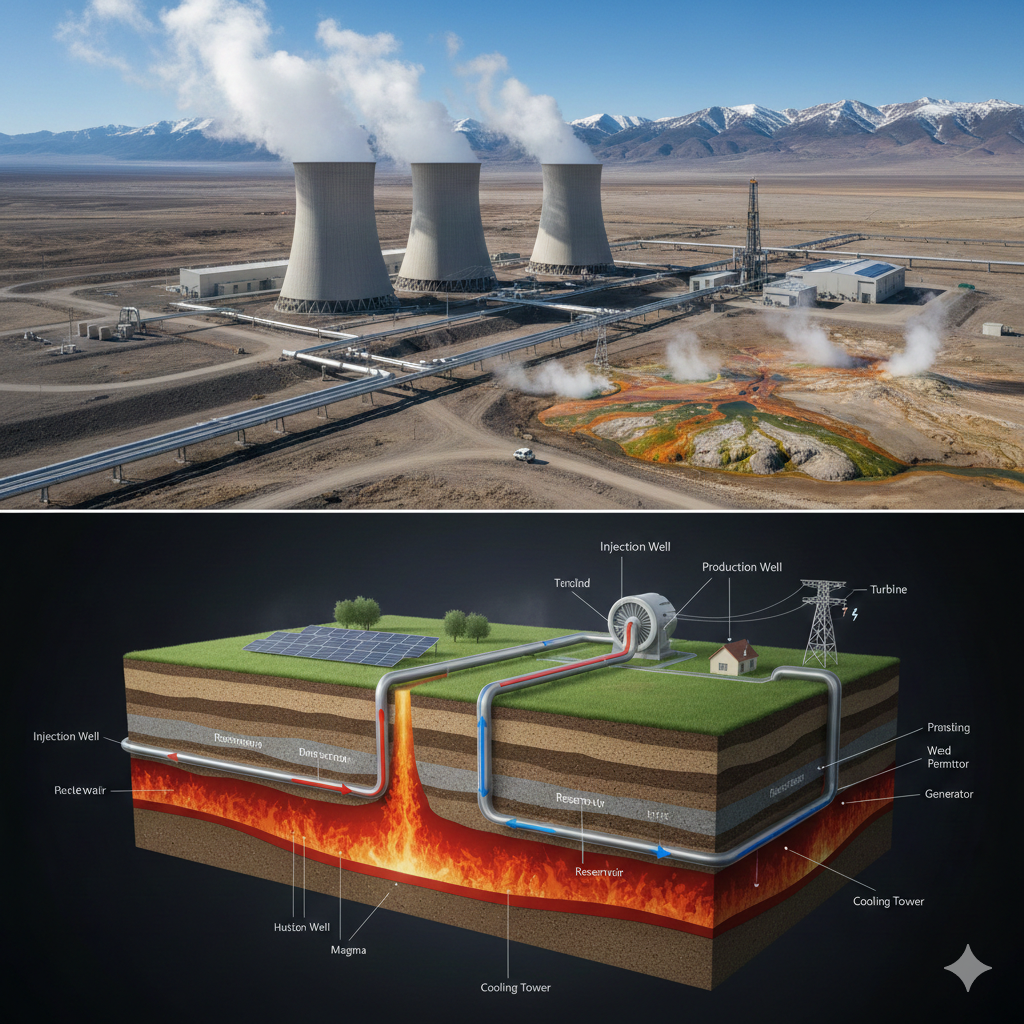
Geothermal power plants convert underground heat into electricity through three primary technologies.
Dry Steam Power Plants
The oldest geothermal technology. Steam flows directly from underground wells into turbines.
Example: The Geysers in California.
Flash Steam Power Plants
High-pressure hot water rises to the surface. When pressure drops, it “flashes” into steam that drives turbines. The remaining water is reinjected.
This is the most common geothermal plant type globally.
Binary Cycle Power Plants
Used for moderate temperature resources. Geothermal water heats a secondary fluid with a lower boiling point in a closed loop system.
Advantages:
- Near zero emissions
- Efficient use of medium temperature reservoirs
- Fully closed loop design
Ground Loop Geothermal Systems Explained
Ground loop geothermal systems are used primarily for buildings.
These systems circulate fluid through underground pipes (horizontal or vertical loops). The ground maintains a constant temperature year-round, enabling efficient thermal heating and cooling.
This is the basis of a geothermal heat pump system, also called a ground source heat pump (GSHP).
Geothermal Heating and Thermal Heating and Cooling Applications
Geothermal energy is not only for electricity generation. It is widely used for direct heating applications.
Residential Use
Geothermal heating systems provide space heating, cooling, and domestic hot water. In 2023, over 155,000 geothermal heat pumps were installed in Europe alone.
Geothermal Heat Pump System for Homes
A geothermal heat pump system works by transferring heat, not generating it.
In winter:
- Heat is extracted from the ground.
- It is amplified by the heat pump.
- Warm air circulates inside the home.
In summer:
- Heat is removed from the building.
- It is transferred back into the ground.
Benefits include:
- 3–5x higher efficiency than conventional HVAC systems
- Lower long-term geothermal cost
- Quiet and durable operation
- Reduced electricity consumption
District Heating and Urban Networks
- Countries like Iceland use geothermal heating to supply entire cities through district heating systems.
- Approximately 90% of homes in Reykjavik are heated with geothermal energy.
Agricultural Applications
Geothermal heat supports:
- Greenhouse cultivation
- Crop drying
- Aquaculture
- Food processing
In China, geothermal greenhouses report significant cost savings and higher crop yields.
Industrial Uses
Industries using geothermal thermal heating and cooling include:
- Paper manufacturing
- Food processing
- Dairy pasteurization
- Textile production
Industrial geothermal reduces fossil fuel dependency and stabilizes operating costs.
Tourism and Thermal Spas
Natural hot springs support tourism industries in:
- Iceland
- Turkey
- Italy
- Japan
- New Zealand
Thermal tourism represents a major economic sector in geothermal regions.
Environmental Impact of Geothermal Energy
Emissions Compared to Fossil Fuels
Geothermal energy produces:
- ~97% less sulfur dioxide than fossil fuels
- ~99% less CO₂ than coal
- Roughly 1/6 the emissions of natural gas plants
Binary cycle plants have nearly zero atmospheric emissions.
Water Usage and Reinjection
Modern geothermal power plants reinject nearly all extracted fluids, preserving reservoirs and minimizing water loss.
Induced Seismicity and Risk Management
Enhanced Geothermal Systems (EGS) may cause minor induced seismic activity. However:
- Monitoring systems reduce risk
- Events are typically low magnitude
- Conventional geothermal plants show minimal seismic impact
Economic Analysis and Geothermal Cost
Initial Investment
Geothermal projects require significant upfront investment due to drilling costs. Wells can reach 2–5 km deep.
Levelized Cost of Energy (LCOE)
| Energy Source | LCOE (USD/MWh) |
|---|---|
| Solar PV | 30–40 |
| Wind | 30–50 |
| Geothermal | 60–100 |
| Hydropower | 40–80 |
| Biomass | 70–110 |
Although geothermal cost per MWh is higher than solar in some cases, its reliability compensates for intermittency costs.
Long Term Economic Benefits
- 24/7 power generation
- High capacity factor (80–95%)
- Stable electricity pricing
- Reduced fuel imports
- High job creation per MW installed
Geothermal Energy vs Other Renewable Energy Sources
Capacity Factor Comparison
| Source | Capacity Factor |
|---|---|
| Geothermal | 80–95% |
| Nuclear | 90% |
| Wind | 25–45% |
| Solar | 15–30% |
| Hydropower | 40–60% |
Geothermal energy functions as renewable baseload power.
Emissions Comparison
| Source | CO₂ Emissions (g/kWh) |
|---|---|
| Coal | ~820 |
| Natural Gas | ~490 |
| Geothermal | ~38 |
| Solar | ~45 |
| Wind | ~12 |
Land Use Comparison
| Source | Land Footprint |
|---|---|
| Geothermal | Very Low |
| Solar | High |
| Wind | Moderate |
| Hydropower | Very High (reservoirs) |
- Geothermal vs Solar: Solar energy is cheaper but intermittent. Geothermal provides stable baseload generation.
- Geothermal vs Wind: Wind is cost-effective but weather-dependent. Geothermal offers continuous output.
- Geothermal vs Hydropower: Hydropower is efficient but environmentally disruptive due to dams.
- Geothermal vs Biomass: Biomass requires fuel supply chains. Geothermal relies solely on Earth’s internal heat.
Advantages and Disadvantages of Geothermal Energy
Advantages
- Renewable and sustainable
- High capacity factor
- Low emissions
- Small land footprint
- Long plant lifespan
- Stable energy pricing
Disadvantages
- High upfront drilling costs
- Geographic limitations
- Exploration risk
- Potential minor seismic activity
Global Leaders in Geothermal Energy
- United States (~3.9 GW installed)
- Indonesia (~2.6 GW)
- Philippines (~2.0 GW)
- Turkey (~1.7 GW)
- New Zealand
- Mexico
- Iceland
Iceland generates ~25% of its electricity and ~90% of its heating from geothermal energy.
Recent Innovations in Geothermal Technology
- Superhot rock geothermal (>400°C resources)
- Closed loop geothermal systems
- High efficiency geothermal heat pumps
- Advanced drilling technologies
- AI driven reservoir monitoring
These innovations are expected to reduce geothermal cost and expand global deployment.
Is Geothermal Energy the Future of Renewable Baseload Power?
As energy systems transition toward decarbonization, the need for stable, low-carbon baseload power increases.
Geothermal energy uniquely combines:
- Renewable status
- Reliability
- Low emissions
- Long term economic value
While solar and wind dominate installed capacity growth, geothermal remains strategically essential for grid stability and thermal heating and cooling applications.
Conclusion
Geothermal energy is one of the most reliable, sustainable, and technically mature renewable energy sources available today. Despite higher upfront geothermal cost, its continuous generation, low emissions, and minimal land footprint make it a critical pillar of the future clean energy mix.
For homeowners, industries, and governments seeking stable renewable power, geothermal heating, ground loop geothermal systems, and geothermal heat pump systems offer long term efficiency and environmental benefits.
FAQs
Is geothermal energy renewable?
Yes. It uses Earth’s internal heat, which is continuously replenished.
How expensive is geothermal energy?
Upfront costs are high, but operational costs are low, and long-term returns are stable.
What is a geothermal heat pump system?
A system that transfers heat between a building and the ground for efficient heating and cooling.
Is geothermal better than solar?
They serve different purposes. Geothermal provides baseload power; solar is intermittent but cheaper to install.